

It was nearing dusk when our bus arrived at our next destination: Tianya Haijiao, which the tour guide had called the most romantic beach in Hainan—and indeed, in all of China.
“If we hold hands with our partner here, our relationship is guaranteed to last until we’re grandparents,” Angela said teasingly on the bus.
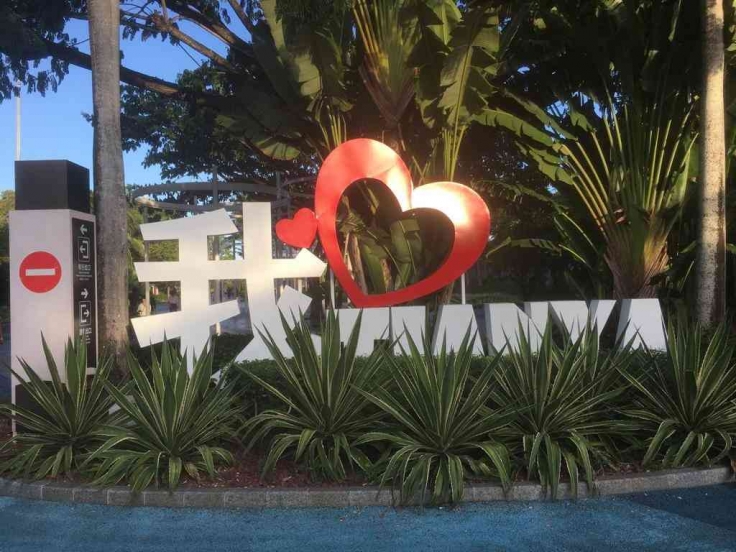
Not far from the bus parking lot, a photo booth was visible with a large sign reading “I Love Tianya,” written in a combination of the Chinese character Wo, a heart symbol, and the word Tianya.
The entrance gate was also eye-catching: above it was a large sign in Cyrillic script, “Group Check-In”—a relic from the era when Russian tourists were the main visitors to Hainan. The original Russian inscription read “Proverky Bilyetov Dliya Grupiy.”
I glanced at the ticket counter. The entrance fee was 68 yuan per person. Not cheap, but the atmosphere was certainly special. We were given an hour to explore, but the area could easily take two or three hours if we wanted to fully enjoy it.
Towards the Beach
I chose to walk. There are electric cars available for a fee of 60 yuan, but walking felt more honest, savoring the sea air and the afternoon beat.
On the way, we saw a monument shaped like two large stainless steel hearts—7.7 meters tall—called Heart to Heart. The pool below was also heart-shaped.
The number 7.7 turned out to be no coincidence: it refers to the 7th day of the 7th month in the Chinese calendar, the day considered the Qixi Festival—the Chinese version of Valentine’s Day—which tells the love story of Niu Lang and Zhinu, two lovers who can only meet once a year on the star-studded bridge.
It also happened to be the seventh month of the Chinese calendar. Perhaps that’s why the place was filled with young couples confidently holding hands.
Statues and Legends
Not far away, a statue of a man in a long robe, with long hair and a thick beard, sits on a stone throne. His face is dignified, almost like a god or wise minister in a classic Chinese tale. Unfortunately, there’s no clear explanation—or perhaps I was in a rush to read it.
Heading to the shoreline, I passed large rocks that appeared to be carved by both nature and man. The scenery immediately reminded me of the granite beaches of Belitung. But admittedly, Tianya Haijiao beach feels more artificial, with a strong commercial feel.
The entrance fee, the cost of an electric car, and even the option of a helicopter ride for an aerial view—all indicate that romance here comes at a price.
But beyond that, the story surrounding this beach remains compelling.
It’s said that a couple whose love was not approved of fled to this shore. While being pursued by family men, a great storm arose, and both were turned into rocks. The pursuers were cursed to become small rocks around them.
From there, two large rocks appeared, bearing the inscriptions “Tianya” (天涯 – the edge of the sky) and “Haijiao” (海角 – the edge of the sea).
The End of the World
The name Tianya Haijiao itself can be translated as “The Edge of the Sky and the Edge of the Sea,” or more poetically: The End of the World.
This nickname stems from the past, when Hainan Island was used as a place of exile for officials or nobles who fell out of favor with the emperor. Its location in the far south of mainland China earned it the nickname “the end of the world”—a place where the sky and the sea seemingly meet without end.
On the other side of the beach, there is also a large rock bearing the inscription “Nan Tian Yi Zhu” (南天一柱), which means “One Pillar in the Southern Sky.” Local legend says this rock symbolizes the fishermen’s prayers for protection from storms by the sea gods.
Exploring the Monuments
I returned to land and discovered several more monuments: statues of gallant cavalrymen, statues of sea gods, and most strikingly—an astronomical monument called the Tianya Haijiao Asteroid, sculpted by a professor from Xiamen University.
This monument depicts an ancient stargazing instrument shaped like a layered ring, with a pearl in the center. The symbolism is clear: Tianya Haijiao was considered the center of harmony between the sky, the sea, and humanity.
When Dusk Came
The sun slowly set in the western horizon, leaving an orange glow in the sky. Small waves lapped at the shore, and the shadow of the stone inscription “Tianya” began to lengthen on the sand.
I paused for a moment, gazing at the gradually darkening sea. For some reason, I felt this place was more than just a tourist destination. It was more like a marker of boundaries—between love and loss, between land and sea, between departure and return.
And as the bus returned to pick us up for Sanya, I remembered the sentence in the small brochure I had read that afternoon:
“Anyone who comes to the End of the World is actually seeking a new beginning.”
Perhaps that’s true. Because at every edge of the sky, there’s always a shore waiting for us to begin again.