

The fierce Hainan Island sun immediately burned our skin as we exited the bus at the Sanya Nanshan Cultural Tourism Zone. It was quite a busy afternoon, with dozens of tour buses lined up, and most visitors had begun waving umbrellas over their heads, even though there was no sign of rain. With the air temperature hovering around 36 degrees, the heat felt searing, but the low humidity didn’t make us sweat at all.
From a distance, the towering statue of Goddess Kwan Yin, the centerpiece of the tourist attraction, could be seen. However, this tourist area is incredibly vast. In fact, according to Angela during our trip, it could cover over 30 square kilometers, comprising the statue area, gardens, forests, parks, and other supporting structures. It would take a full day to see it all!
From the bus, we entered through the ticket gate. Several members of our group were called and given their passports. It turned out that those over 60 years old were free to enter, while the entrance fee was 108 Yuan.
A large, tiered gate with a traditional Chinese roof greeted us. In front of it stood a large stone with the name of the place in Mandarin script engraved in red. Uniquely, to read it, we had to start from right to left, similar to Arabic script. I could tell this from the order of the Nan and Shan characters. Modern Chinese characters are read from left to right, while classical Chinese characters are read from right to left.
To reach the statue of the Goddess, we had to take two electric cars, similar to a “odong-odong” (traveling cart). The fare was 30 Yuan for one ride and 10 Yuan for a round trip. There was also the option of walking. Although the location was comfortable, we all opted for the odong-odong (traveling cart) to avoid walking in the hot sun and save time.
On one side of the expansive park, a large sign displayed a map of the area, with the Kwan Yin statue located in the southernmost part, jutting out into the South China Sea. “Brahman Pure Land, Longevity as Nanshan,” read the map. Meanwhile, in another area, there’s another photo spot with a beautiful flower garden as a backdrop, along with the name of the place in Chinese and its designation as a National AAAAA Tourist Attraction. For your information, in China, all tourist attractions are rated by the government, and the best ones receive a 5A or AAAAA rating.
Approaching the statue of the Goddess, another row of large, pagoda-like pillars adds to the religious atmosphere. Right at the base of the building is a place for visitors to pray using incense. After praying, they enter the room and then take the elevator up to the fourth floor. According to Angela, when the Buddha statue was first inaugurated in 2005, the Chinese government initially prohibited visitors from praying. However, this ban was ignored, and as a result, more and more visitors, both from across China and abroad, have come to visit, both for sightseeing and for worship.
From here, the statue of the Goddess, which stands 108 meters tall, appears to tower over the entire building. It is said that when it was completed, this statue was the tallest in the world, even taller than the Statue of Liberty in New York City. The statue apparently has three faces, one facing Hainan Island and the other two facing the South China Sea. Each hand on each side of the statue holds a lotus flower, a book, and prayer beads. This is said to symbolize wisdom, peace, and compassion.
I then entered the room beneath the statue. It turned out to be a beautiful temple with many statues of Buddha and the Goddess Kwan Im inside. One large statue was even made of gleaming gold. There was a queue to take the elevator to the Goddess’s feet. Although quite long, the line moved smoothly, and soon I was on the elevator going up. From the fourth floor, we had to walk a circuitous flight of stairs to the seventh floor, which is an open courtyard right at the feet of the Goddess Kwan Im.
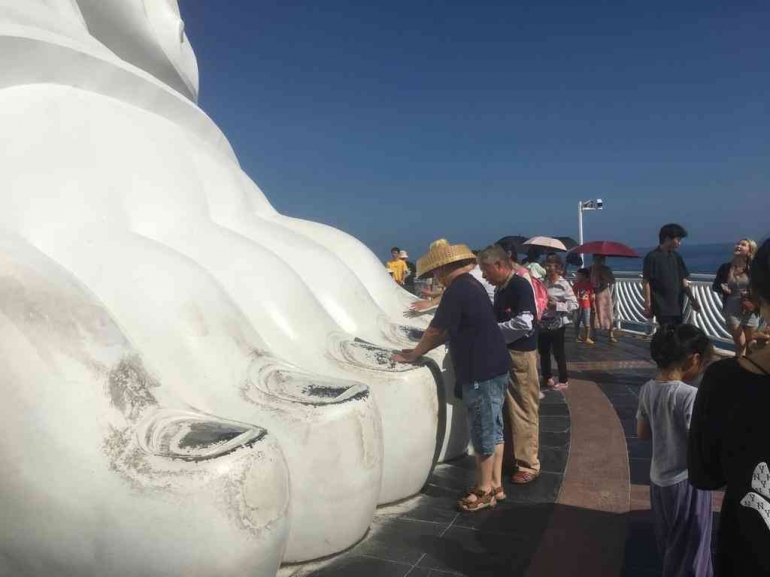
On the seventh floor, the congregation walked clockwise around the statue, as if performing the tawaf (circumambulation). Occasionally, they place their right palms on the feet, or more precisely, the goddess’s toenails, while bowing respectfully. Some also hug and kiss the statue’s feet as if they never want to be separated again. From up here, the view of this religious and cultural tourism area is clearer. The gate is visible in the distance, as well as the 280-meter-long Puji Bridge that connects the goddess statue area to the mainland. The main building. People looked tiny from the height of the seventh floor.
After enjoying the view of the sea and the people at the foot of the statue, I returned down the stairs in a different direction. Unlike the climb, the descent involved taking the stairs, and along the way, I was treated to views of several equally beautiful statues. A middle-aged woman knelt reverently in prayer before the statue, and there was also a statue with many arms.
Upon arriving at the bottom, I looked up again and realized that beneath the seventh floor where I had climbed, there were golden lotus petals, seemingly standing on the statue’s platform.
After about 45 minutes in the statue area, we returned by car or electric odong-odong to the main gate. This time, however, the route took a detour to various points of interest in the area. One such attraction was the marble wall inscribed with beautiful Chinese characters.
It was nearing dusk when we walked back to the bus. Most people had already returned to their vehicles. Some people even offered taxis back to downtown Sanya.
A memorable afternoon and evening at the foot of the statue of the Goddess of Mercy in Nanshan. For those who may not know, Hainan means South Sea, and Nanshan means South Mountain.