

Our trip to Hainan Island began with a brief stop in Sanya, the second largest city in Hainan Province and a city with many Russian-language signs and road signs. With a local tour guide named Angela, also known as Xiao Lung, our group enjoyed the bus ride along the smooth roads in southern Hainan.
Angela told us a lot about Hainan Island and its warm beaches. The August air was quite hot, with temperatures hovering around 36 degrees Celsius. We passed a Chinese Navy facility complex that looked somewhat eerie, with walls covered in propaganda writing and the hammer and sickle logo reminiscent of a communist country. According to Angela, the Chinese Navy has many excellent facilities on Hainan Island, including a fairly large and well-equipped hospital.
Our first stop was a short stop at a beach not far from Sanya. It was called Dadong Hai Beach, which Angela explained was also called Russian Beach. This is due to the large number of Russian tourists who visited this beach before the COVID-19 pandemic hit. This is also why Sanya City and its surroundings, and even parts of Hainan Island, are still filled with signs and directions in Russian.
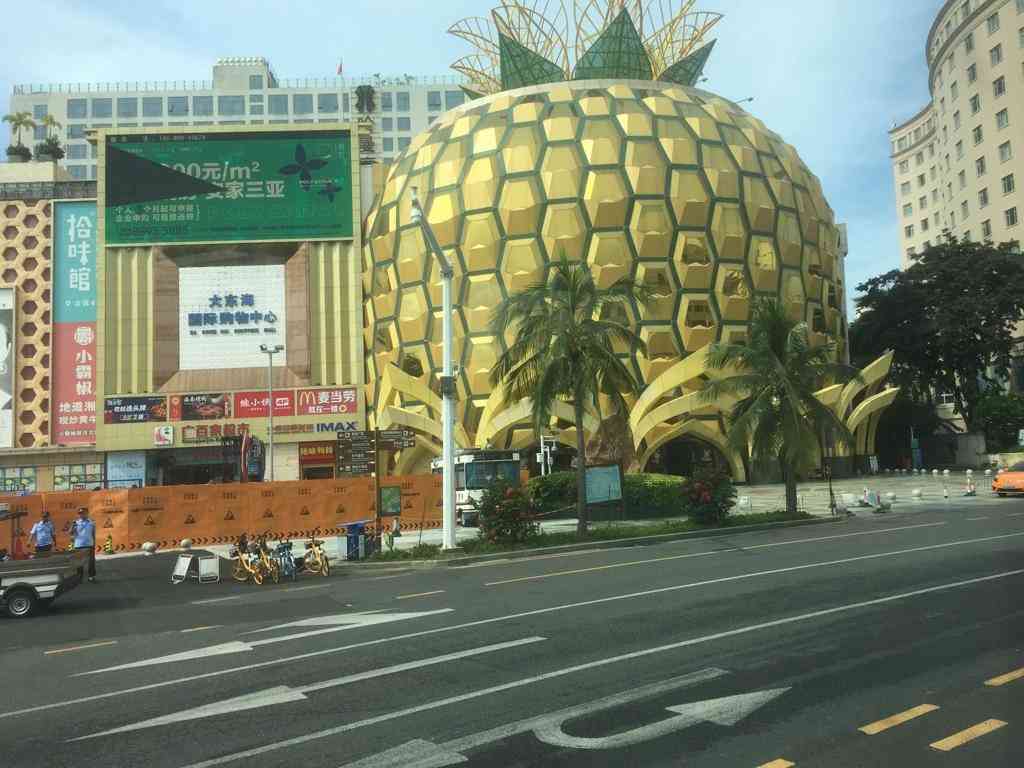
On our way to Dadong Hai Beach, we passed a uniquely pineapple-shaped mall. It was called Dadong Hai Shopping Mall. Not far away was a restaurant building with Chinese and Russian writing. “Hermitage Restaurant,” I read the Cyrillic sign. This time, there was no English sign. It turns out pineapples are also a major agricultural product on Hainan Island.
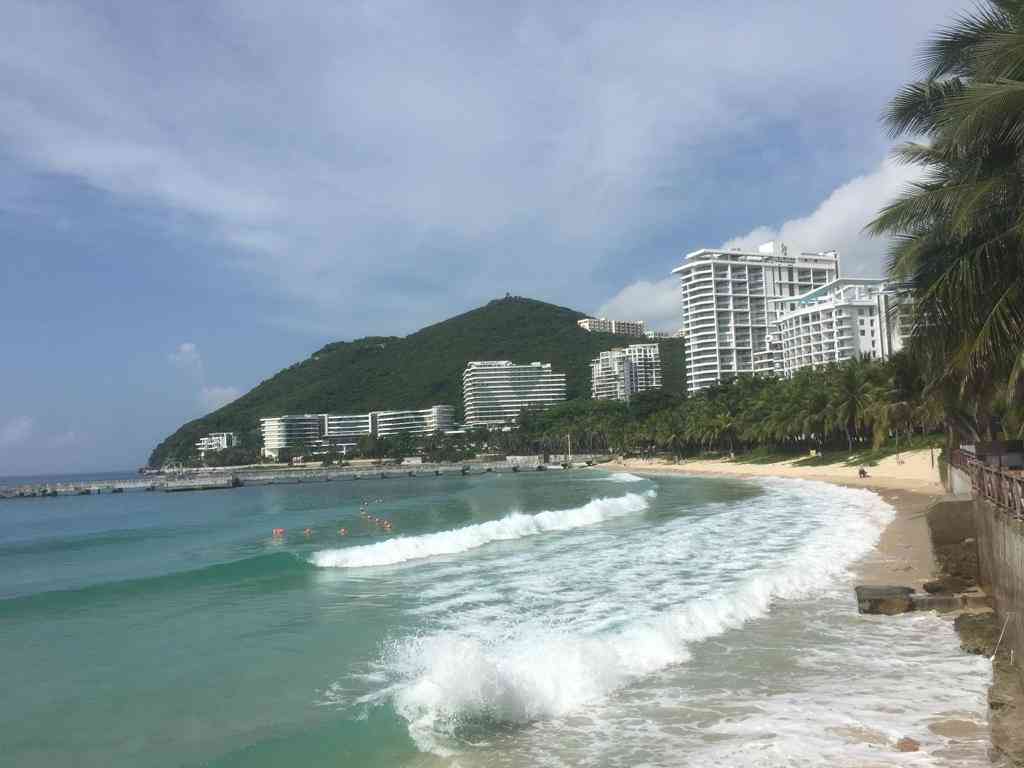
Our bus stopped in the parking lot at Dadong Hai Beach. At first glance, we saw crashing waves and a stretch of white sand with swaying coconut trees. The atmosphere resembled beaches in tropical countries. However, the rows of hotels and apartments along the beach have earned Hainan the nickname “Hawaii of China.” According to Angela, in addition to Russian tourists who have visited Hainan, many local tourists from northern China also visit. Especially in winter, when temperatures can reach minus 50°F (-20°C) in Beijing, while Hainan remains warm, hovering above 20°C (-60°F). It’s no surprise that many of the apartments scattered across Hainan Island, both around Sanya and as far north as Haikou, are owned by people from Northern China who make it their second holiday home. Many retirees also purchase apartments in Hainan.
“Although the beaches around Sanya look serene and beautiful, only some are safe for swimming. This is because the beaches around Hainan Island are also famous for their sharks,” Angela added. I then noticed that the safe swimming areas were demarcated by inflatable balls floating around the beach.
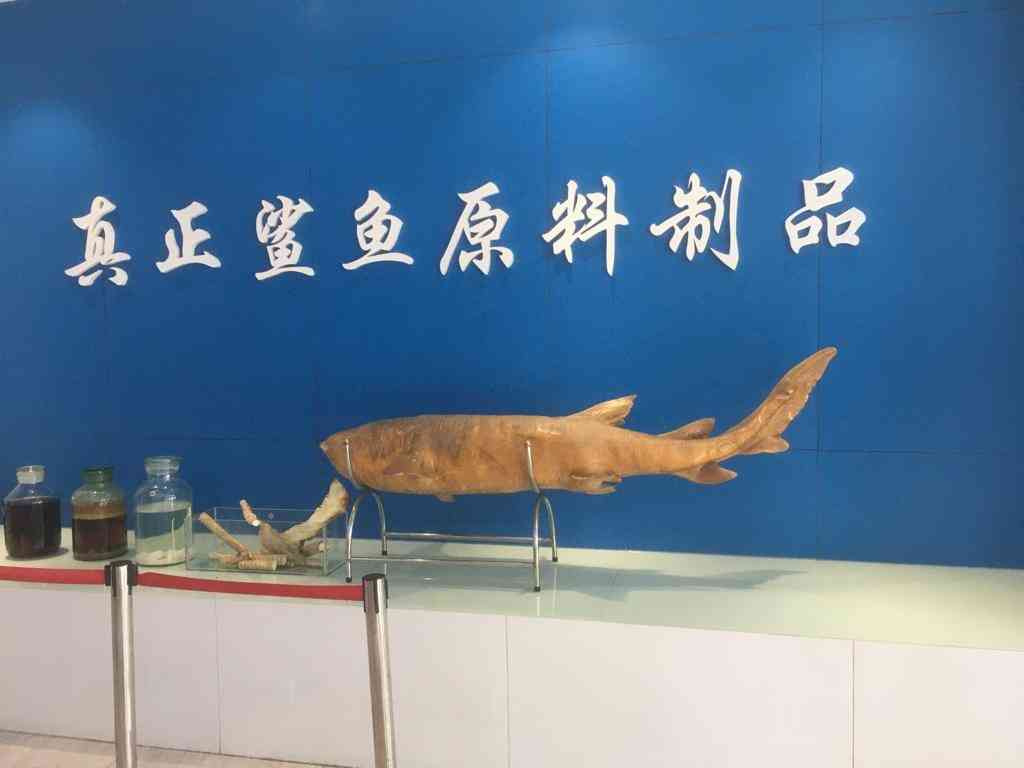
Angela’s story about sharks around Hainan Island was no joke. The next place we visited that morning was a fish oil factory. And the main ingredient for fish oil is not salmon, as we often know as Omega Three, but oil extracted from sharks found around Hainan Island. Sharks are even farmed and cultivated around the island.
Besides shark oil, this factory also sells a variety of seafood, including dried seaweed, packaged for takeout.
During the tour, the tour guide also talked extensively about Hainan Island, China’s smallest and southernmost province. Furthermore, its tropical climate and consistently clear blue skies make Hainan’s air quality among the cleanest in China. Understandably, there’s less heavy industry here than on the mainland. With a population of around 9 million, Hainan Province is indeed one of the smallest and least populated provinces.
And it turns out that Hainan’s status as a province is also relatively young. Hainan Island, which means “Southern Sea,” was previously part of Guangdong Province and only in 1988 was it separated from China as a sheng, or province. Now, Hainan Island is separated only by a narrow strait called the Qiongzhou Strait.
Besides numerous coconut trees, Hainan is also abundant in areca nut trees. At first glance, their leaves resemble those of the oil palm. It turns out that Hainanese, especially the elderly, have a habit of chewing betel nut. This was also done by the bus driver who took us around Hainan Island.
So, if you want to try betel nut or breathe clean air, come to Hainan.