

My trip to Macau wasn’t over. After visiting the Grotto Luiz de Camões—a small cave where the one-eyed poet is enshrined—yellow bus number 18, bound for Portas de Cerco, or Border Gate, took me to my next destination: the Mesquita e Cemitério de Macau, or Macau Mosque, which houses an old cemetery complex.
This visit felt like a trip back in time—retracing the same journey eight or nine years ago, when I arrived at the same place by walking along the beach.
In a Bus with Four Languages
Riding a bus in Macau is an experience in itself. While a bit crowded and not as comfortable as Hong Kong, the journey through the narrow streets of the old town of the Macau peninsula is still enjoyable. The voice of the automatic bus announces the names of the stops in four languages—Portuguese, Cantonese, Mandarin, and English. The Portuguese names of the stops sound exotic, as if the remnants of Portuguese colonialism still echo in the air.
On the bus, I met three young Indonesian women. They were between twenty and thirty years old and worked as Indonesian Migrant Workers (BMI). Apparently, there is quite a large Indonesian diaspora living and working in Macau. Unexpectedly, all three had the same destination: the Macau Mosque. The trip felt more intimate with the presence of an impromptu tour guide.
An Old Gate with Four Languages
We got off at the bus stop called Dom Bosco Sport Field, located on Avenida do Cel Mesquita. From there, we walked for about five minutes to a small street called Ramal dos Moros. On the right side of the road stood an old, worn gate, partially covered in moss.
However, the inscription “Bismillahirrahmanirrahim” (In the name of God) above it was still clearly legible, alongside inscriptions in four languages. The door was made of green iron railings, with a faded yellow crescent moon and star symbol above it.
Dim Sky and White Mosque
Entering the gate, we descended several steps to the mosque’s spacious courtyard. The sky was beginning to dim even though it was only five-twenty. In the distance, the main white mosque building loomed, with its large arched windows, shaded by shady old trees.
Turning left, we came upon a small green building: the office of the Associação Islâmica de Macau, or Islamic Association of Macau. It was a simple structure, with a terrace housing a few long wooden tables and benches. There I met several other women—all Indonesian.
One of them wore a niqab, with only her eyes visible. In a modest tone, she said, “I happen to live nearby, so I often help out when there are activities at the mosque.”
Among Graves and Starfruit Trees
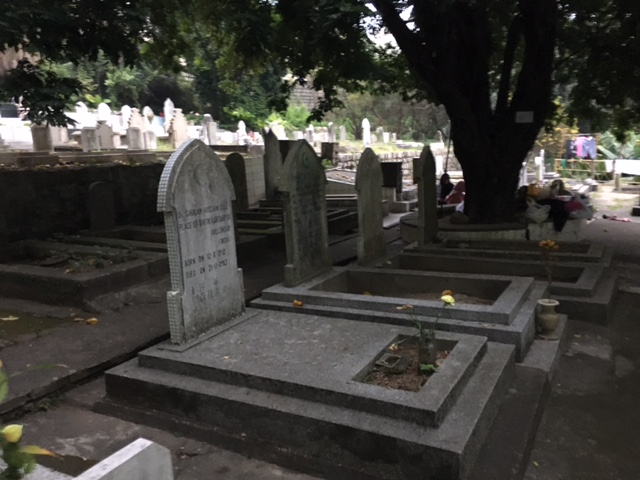
Waiting for the evening prayer, I walked to the backyard, which turned out to be a Muslim cemetery. Rows of graves with various headstones stretched out before me. At first glance, they looked poorly maintained, but some had recently been decorated with flowers or small containers of water—a sign that visitors were still visiting.
A tombstone reads:
“In Loving Memory of Rukan Din, Born in 1903, India — Died 2-7-1970 in Macau. Gone but not forgotten.”
At the head of the grave is engraved a crescent moon and a green star. On another gravestone, “Nurullaha Quburahu” is written in Arabic script, accompanied by green Chinese characters. As in Hong Kong’s Muslim cemeteries, the endings -hu and -ha indicate whether the burial is male or female.
Under a large tree, I greeted several women sitting on mats, chatting casually while enjoying their unfinished lunches. “Assalamualaikum,” I greeted.
“Waalaikum salam,” they replied in unison with smiles.
It turned out they were migrant workers who had made this cemetery a place to rest on their days off. Not in a mall or a city park, but among the graves—a place that actually offered a special kind of tranquility.
Several starfruit trees grew luxuriantly between the gravestones. The fruit hung, some turning yellow and scattered on the ground. “It tastes a bit sour,” one of them said when I asked why they left it there. We chuckled, our conversation in a mix of Indonesian and Javanese with various accents.
Old Graveyards and Macau Twilight
The further we got to the edge of the complex, the older and mossier the gravestones became. The carved letters were difficult to read, as if time had slowly erased the names. Some were said to be hundreds of years old, relics of Indian and Pakistani Muslim traders who once settled in Macau.
Dusk was falling. The evening call to prayer echoed softly from a white mosque in the distance. Its sound cut through the humid air of Macau that afternoon—amidst the bustle of casinos and grand hotel towers. Here, in a quiet courtyard filled with starfruit leaves, life and death coexisted peacefully.
Hanging out in a cemetery? Who’s afraid?
Sometimes it is in the quietest places that we find the most peaceful life.