

While we spent the afternoon and evening in Kobe yesterday, we left our apartment in Kikawahigashi early this morning. We took an online taxi to Shin-Osaka Station—a major hub for Kansai travel—because today’s route was longer: Kyoto and Nara.
Shin-Osaka always feels like a gateway to the future. Grand, modern, and busy. It’s known as a Shinkansen station, but for travelers who prioritize cost efficiency, the local JR network is often a more sensible choice. Usually, I’m the one busy deciding which route and train to take, but today was different. My son took over as tour leader. I just tagged along—which turned out to be convenient, just occasionally checking to make sure we didn’t go the wrong way.
We entered the station area, passing through neatly marked floor signs—even the entry instructions for various ticket types, including IC Cards, were clearly marked on the floor. We headed to the JR gate, tapped our ICOCA and PASMO cards, and entered the efficient and nearly flawless world of Japanese railways.
Our first destination was Kyoto, taking the JR Kyoto Line Rapid Service (Kaisoku). It was a perfect choice: not as fast as the Special Rapid, but also without stopping at every station like local trains. As the train moved along, Osaka’s landscape gradually changed—the tall buildings faded away, replaced by quieter suburbs. In about 35–40 minutes, we arrived at Kyoto Station.
Kyoto greeted us with a different rhythm. Not as busy as Shin-Osaka, but still lively. The signs were very clear. We just needed to find platforms 8–10, where the JR Nara Line departs. This is where a small detail became important: only local trains (Futsu) stop at Inari Station. We let the Miyakoji Rapid train pass. Shortly after, a local train arrived.
The carriage was quite crowded with foreign tourists, but we still found seats. The train took us through southern Kyoto—typical Japanese rural houses, trees, and a daily life that felt simpler than Osaka or Tokyo. Inari Station was only one stop away, about a five-minute journey. As soon as the doors opened, almost all the passengers disembarked.
There was no confusion. No questions. Just going with the flow. Exiting the station, tapping your card on a simple device manned by an attendant—there wasn’t even a gate with a traditional exit. If your card balance was low, a top-up machine was available at the side of this small station.
As soon as we stepped out, Fushimi Inari Taisha stood directly across the street. There was no psychological distance between modern transportation and sacred space. The two simply met.
The Kyoto air was cool
and clean. Our breaths puffed thinly. Before us, a giant vermilion Torii Gate loomed majestically under a cloudy sky. There was a bustle—not the hustle and bustle of the city, but the enthusiasm of pilgrims and tourists.
In one corner, my attention was drawn to a jet-black fox statue (kitsune) lying gracefully on a parapet. Kitsune are messengers of the god Inari. The morning sun touched the tip of its snout, giving it a mysterious yet warm feel. Behind it were traditional shrine walls and trees still bare—a sign of late autumn or early winter.
Before we entered further, a sign in four languages warned:
“Fushimi Inari Taisha is a place of prayer. Let’s pray in peace and quiet.”
We bowed for a moment, allowing ourselves to embrace the requested silence.
In the courtyard, the red-orange shrine buildings stood majestically, guarded by kitsune statues. Before proceeding further, we stopped at a temizuya—a Japanese ablution place. Clear water flowed from the mouth of a stone fox statue. Hands were washed, mouths rinsed carefully. It wasn’t just about cleansing the body, but also calming the mind. The city, trains, and modern time seemed to be left behind here.
Fushimi Inari Taisha has stood since the 8th century, dedicated to Inari Ōkami, the god of rice, prosperity, and good fortune. In ancient times, rice was life. Today, rice cultivation has transformed into business, commerce, and enterprise—but the prayers remain the same.
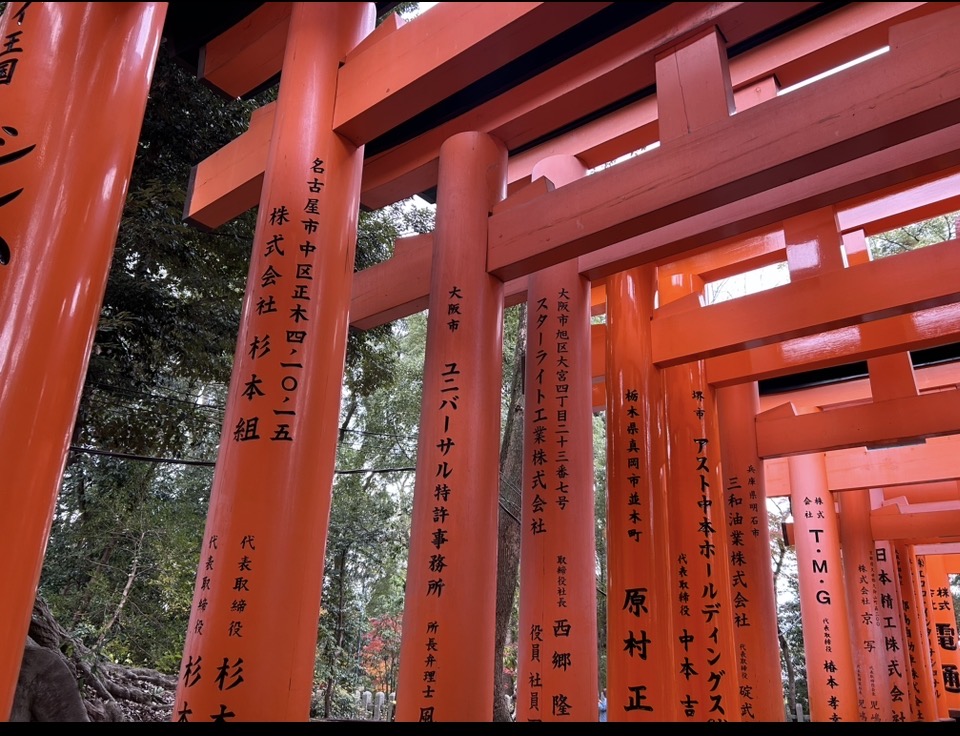
That’s why thousands of red torii stand in rows. Each gate represents a donation. Each engraved name represents a wish.
We saw a large wooden map—a hiking trail to Mount Inari, lined with torii symbols that resembled an endless tunnel. We began walking.
As soon as we entered the Senbon Torii, the atmosphere changed drastically. Vermilion engulfed our view. Sunlight filtered through narrow gaps, creating a dim, almost mystical glow. Black kanji were engraved on each pillar—names, dates, and prayers. This passageway was not just a hiking trail, but a collective archive of human hope.
Step by step, my breathing grew heavier. We hadn’t reached the summit—only halfway. My feet were giving me a subtle signal that the day was still long. Nara waited.
At Fushimi Inari, stopping halfway wasn’t a failure. In fact, that’s where the little lesson came in: not every pilgrimage has to reach the summit. Sometimes, it’s enough to go as far as the body and heart agree.
We turned around. The descent down the torii passage felt lighter. The light seemed brighter. Human voices returned.
In front of the main gate, we paused for a moment. We took one last photo. My wife stood in her pink prayer robe, contrasting beautifully with the orange torii. I stood beside her, my white jacket, amidst the steady stream of tourists. In that frame, it was just us—and the journey we’d just taken.
Inari Station was once again our gateway home. The JR Nara Line awaited. We left Kyoto without guilt. It had given us enough: holy water, a torii passage, and a lesson on when to stop.