

Compared to Hong Kong, Macau always comes second, except when viewed from a historical perspective, antiquity, and several cultural uniqueness. Macau has been a Portuguese colony since the 16th century, much older than Hong Kong, which only became a British colony in the mid-19th century. One unique legacy that remains to this day is the widespread use of Portuguese, evident in the names of buildings, places, and streets.
Arrival and Ease of Transportation
After approximately an hour by jetfoil or speedboat from Macau Ferry Terminal in Sheung Wan, Hong Kong, we arrived at the Terminal Maritimo de Passageiros Exterior, or Outer Harbour Ferry Terminal. This terminal is the main ferry and helicopter port in this former Portuguese colony. The arrivals signs at the terminal read Chegadas, or Arrival.
Immigration was very smooth. Indonesian passports do not require a visa for a 30-day stay. Interestingly, passports are not stamped as they are for entry and exit from Hong Kong. We were simply given a piece of computer-printed paper to keep and present upon leaving Macau—a far cry from the 1980s, when a visa-on-arrival fee of 50 Hong Kong dollars was still required and a stamp was left in our passports.
Travelers needn’t worry about getting to their hotels. Taxis, buses, or free shuttle buses serve almost all areas of Macau, both on the Macau Peninsula and the luxurious hotels and casinos on Taipa Island. Simply hop on and select your destination. Free Wi-Fi is also available on the shuttle buses. Guests and non-guests alike are welcome to ride, hoping visitors will also stop by the casinos.
Admiring Lotus Square and the City’s Cleanliness
Our first stop on our afternoon trip to the Macau Peninsula was Lotus Square. This expansive square is adorned with a gilded bronze monument in the shape of a blooming lotus flower, approximately six meters tall. This monument was presented by China to mark the return of sovereignty to Macau from Portugal in 1999. Its base consists of three tiers of reddish-brown granite, representing the three regions of Macau: the Macau Peninsula, Taipa Island, and Coloane Island. Surrounding it, the Chinese and Macanese flags flutter proudly on tall poles.
Of particular interest are the cleanliness campaign signboards. One depicts a person spitting into a handkerchief, while another person gives a thumbs-up. The text, written only in Chinese characters and translated into Portuguese as “Por favor nao cuspa para o chao” (Please Do Not Spit on the Floor), also includes a warning in three languages (Chinese, Portuguese, and English) that spitting indiscriminately can result in a fine of 600 MOP (Pataca). It also bears the slogan: Cidade Nossa Cidade Limpia (Our City is a Clean City).
I then took the elevator down and crossed the underground tunnel beneath Avenida de Amizade, with signs reading “Passagem Inferior Para Peoses” or “Subway” (Pedestrian Tunnel).
From here, I headed to the large park in front of the Sands Hotel and Casino, which is said to be a Las Vegas branch. This circular fountain park is called Largo de Monte Carlo, or Monte Carlo Square.
In the tunnel near the Macau Ferry Terminal, I saw a sign promoting the Festiva de Luz de Macau Tesourosos de Luz, which runs from December 4th to 31st, 2016. This is a Festival of Lights that illuminates historical monuments, hotels, and casinos in a city whose gambling revenue reaches tens of billions of dollars annually.
Christmas Atmosphere and Unique Traditions
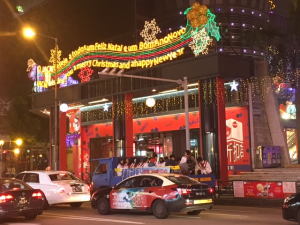
It was no surprise that that night, almost every building, from monuments and old buildings to casinos and hotels, was bathed in lights. As December drew to a close, many also had illuminated signs in Portuguese: “Feliz Natal e Bon Ano Novo,” which means Merry Christmas and a Happy New Year.
While waiting for the shuttle bus back to the hotel, right at the intersection of Avenida de Don Joao IV and Avenida do Infante Dom Henrique, a pickup truck suddenly passed by. A group of teenagers cheerfully sang Christmas carols, dressed as if they had just finished mass. While waiting for the bus, the group passed by twice. Apparently, these Macanese teenagers were wandering around the city singing, a tradition similar to the takbiran (prayer) held in Indonesia to celebrate Eid al-Fitr.
It turns out that a similar tradition exists in Macau, and it also provides a unique opportunity to learn Portuguese!