

At eight minutes past eight, the commuter train from Bekasi finally pulled into platform 1 of Tanah Abang Station. The once-crowded station now looked grand, spacious, and multi-story. That day, I was participating in the Clickompasiana activity with Kreatoria. Our goal was simple but moving: a trip to Rangkasbitung to visit the Multatuli Museum.
Upstairs, I met Ms. Mutiah and Mr. Ikhsan. “Near the entrance,” was their message via WhatsApp. Shortly after, John Purba and his third-grade son appeared. We then hurried to platform 6. There, we waited for the train to Rangkasbitung, waiting for Tatie, who finally arrived just before the train docked. The group from Tanah Abang was complete. The others—Mr. Sutiono, Zarna, Daniel, and Hani—would follow directly to Rangkasbitung.
The train arrived promptly at 10:30. Rangkasbitung Station is also magnificent, although some corners are still under renovation. We stopped briefly to catch our breath and take some photos, then exited the station and took a minibus to the town square. After stopping at a minimarket, we continued our journey to the Multatuli Museum. In the museum courtyard, other participants were already waiting; the day’s exploration had begun.
This wasn’t actually my first visit. I’d been there about three years ago. The courtyard remained similar, although there had been some changes. At the entrance, a large poster titled “Epilogue 2025 #2: Rangkasbitung Zero Point” was displayed. The art exhibition, which ran from December 14–18, 2025, involved artists from Bali, Yogyakarta, and local artists from Banten. This collaborative event was part of the celebration of the 197th anniversary of Lebak Regency.
Museum entrance tickets were only Rp 2,000 for adults, Rp 1,000 for children, and Rp 15,000 for international tourists (who happened to be missing that day). After purchasing my ticket, I explored the pavilion. There, a large banner read “Lebak Chapter Declaration – Saturday, December 20, 2025, Multatuli Museum.” In another corner, there was a booth “Bayah Dome Geopark Corner.”
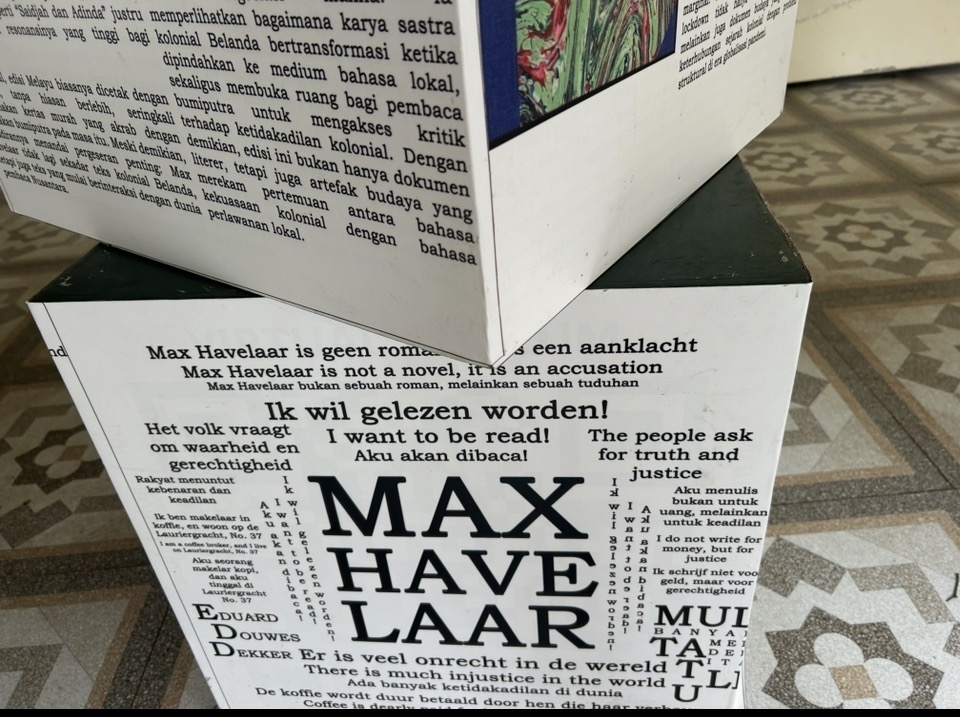
Right near the museum entrance, several information cubes about Max Havelaar were arranged. On one of them was a rather scathing quote:
“Max Havelaar is geen roman, het is een aanklacht.”
“Max Havelaar is not a novel, it is an accusation.”
“Max Havelaar is not a novel, but an accusation.”
That sentence struck a chord in my mind. An accusation, not a novel. Perhaps that’s why Multatuli’s work, from the 19th century, remains relevant: he challenges the colonial system and forced cultivation practices that demean human dignity.
On the other side, there was the Lockdown edition (2020–2021), a literary experiment that blends colonial narratives with the metaphor of a zombie outbreak, seemingly reviving social criticism through the aesthetics of horror. There’s also a 150-Year Jubilee edition (2010), as well as translations into various languages, from early 20th-century Malay to a South African version from 2025. It’s fascinating to read how the story of Saijah and Adinda travels across borders and eras, appearing in dozens of languages, as if the suffering caused by injustice always finds its readers.
The next two displays detail Multatuli’s life: his arrival in Batavia in 1839 as a clerk, and his subsequent assignments in West Sumatra, Purwakarta, Bagelen, Manado, and Ambon. In 1856, he became Assistant Resident of Lebak, Banten—a man of integrity—with a strong and firm stance on principle, which led to conflict with his superiors. It was from this experience that he expressed his protest in Max Havelaar (1860).
Another display details the end of Dekker’s life in Germany. After separating from Tine, he married Mimi, who faithfully took care of his finances and manuscripts. Ironically, despite his fame, Dekker lived in financial hardship until his death on February 19, 1887.
I stepped into the first room of the museum. On the wall was a bright red inscription: “The Duty of Man Is to Be Man.” A simple sentence, yet full of moral challenge; the essence of Multatuli’s humanism. Below the inscription was an illustration of a polygon forming Multatuli’s face. On the right side was a traditional weaving tool, as if recalling the struggle of the Bantenese people before colonial policies forced them to submit to the economic system of capitalists.
In another corner was a model of a building. It turned out the museum occupied the former Lebak Regency office, built around 1923. The model depicted the colonial structure of Rangkasbitung and the spatial layout of the past.
In the next room was a map of the Maluku Islands. Dutch ships with red, white, and blue flags were depicted plying the ocean. Maluku, “The Spice Islands,” was fought over by Europeans. Spices were more valuable than gold at the time. There is a display of spices in glass cases: nutmeg, pepper, cloves, cinnamon—the early traces of colonialism that sparked a long history of exploitation of the archipelago.
In another room, quotes about Multatuli are displayed. Kartini’s quote immediately caught Kartini’s attention:
“I have Max Havelaar because I really, really like Multatuli.”
The lines she wrote in her letters demonstrate Multatuli’s profound influence on Kartini’s awareness of colonial injustice.
In another room, W.S. Rendra’s poem, “The People of Rangkasbitung,” is displayed. This long poem is required reading to understand the paradox of colonialism: injustice neatly packaged, unjust decisions made with grace. The bitterest irony is the depiction of the Dutch praying, eating together, dressed neatly, while enjoying the profits from the forced coffee trade.
Rendra was known for his sharp criticism of power. His poetry feels relevant not only during the colonial period or the New Order, but also today—when injustice often proceeds with polite faces and kind words.
In another corner, various translations of Max Havelaar are displayed. I read a few pages. I remembered having a collection of H.B. Jassin and other versions translated from English. On the front page is a quote from Pramoedya Ananta Toer, taken from the New York Times (1999):
“The story that killed colonialism.”
This sentence reinforces the impression that Max Havelaar is more than just a work of literature; it is a symbol of universal moral struggle.
The museum tour concluded with a visit to the statues of Multatuli, Saijah, and Adinda in the courtyard. The statues left a reflective silence, as if the ruins of colonialism still lingered. We concluded our exploration while waiting for dusk to slowly fade over Rangkasbitung.
On the way home, I remembered the sentence on the museum cube: Max Havelaar is an accusation. Perhaps today a new accusation is born—not of colonialism, but of ourselves. Have we become human, as Multatuli believed humankind was supposed to be? Or are we instead part of a long historical process that seems to have ended, yet still holds many wounds?