

Our journey through Rangkasbitung continued on foot, leaving the Multatuli Museum with a cheerful feeling. That afternoon, the sun felt kind, even shyly showing itself. The air wasn’t too hot, just pleasant enough for a journey intended as a historical journey, not just a tourist attraction.
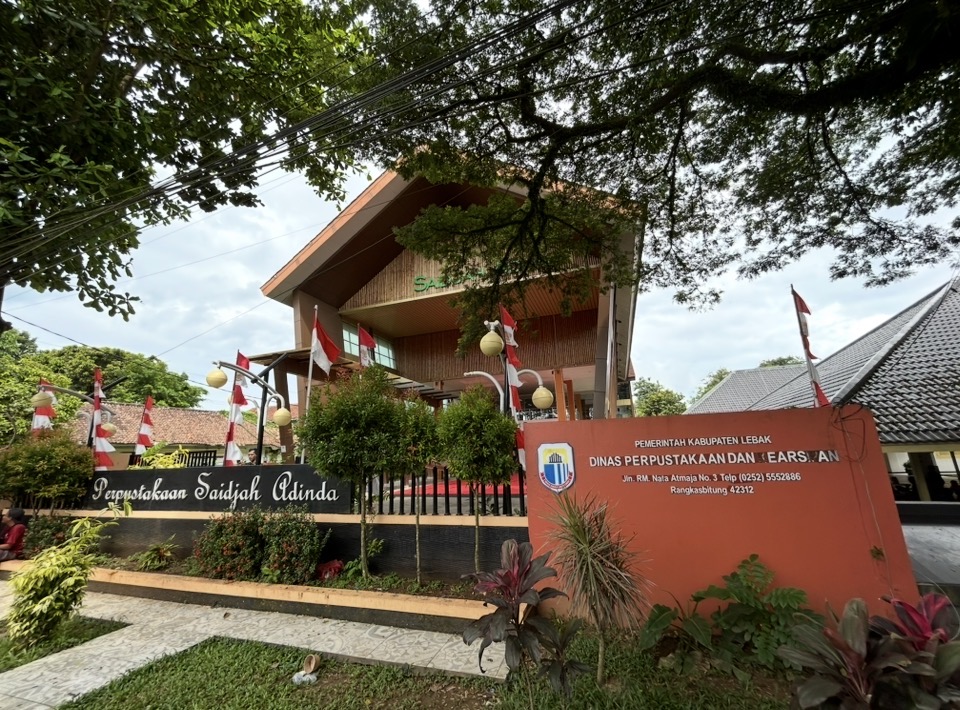
Mbak Mutiah led the group. My friends and I followed behind, keeping our distance and enjoying the rhythm of our steps. The first building that caught our attention stood directly to the right of the Saijah Adinda Library: an old colonial courthouse, or Landraad in Dutch East Indies lingo. According to historical records, this building had been standing since 1923 and ceased its function as a court in 1975. A cultural heritage marker was displayed in front of it. Ironically, a banner also hung right at the entrance, prohibiting entry because this building belonged to the Rangkasbitung District Court. The yard was spacious, but the impression was one of neglect—like history fenced off, not cared for.
We crossed the street into the heart of town. Rangkasbitung Square is currently under renovation and covered in corrugated iron. A large sign states that the project will be completed by the end of December 2025, with a budget of hundreds of billions of rupiah. Hopefully, this square will truly become a welcoming public space, not just a pretty sight in the inauguration photos. From this point, history seemed to flow alongside our footsteps towards the hospital area. Who would have thought that from the neatly arranged museum, we would instead be heading in the opposite direction: Multatuli’s abandoned and nearly forgotten house.
A few minutes’ walk, we arrived at Dr. Adjidarmo Regional Hospital. The building is large and imposing, predominantly white with blue accents on the facade. The courtyard is bustling with street vendors, and life goes on as usual. We entered through the side yard and met a security guard to request permission to visit Multatuli’s house, located behind the main building.
It turns out that entering this cultural heritage area isn’t as easy as entering a museum. According to the security guard, we should have emailed and obtained permission several days in advance. Ms. Mutiah went into the main building to process the permits while we waited and chatted.
“Quite a few communities come to Multatuli’s house,” said the brown-uniformed security guard. “Sometimes there are also tourists from the Netherlands or European countries.”
Soon, Ms. Mutiah returned. The guest book had been filled out, and the permits were in hand. We were invited to enter alone. The security guard even asked if we knew where her house was. Ms. Mutiah confidently replied that we did—though that confidence would later be tested.
We walked along the side yard to the back of the hospital. Many small buildings stood there, including a signpost to the morgue. Even Ms. Mutiah, who had been here before, had forgotten the exact location of the house we were looking for. We wandered around, confused, until finally asking a nurse, who then led us to the front of Multatuli’s former residence when he served as Assistant Resident of Lebak.
In front of the house, three large boards stood as if deliberately placed to mask the harsh reality behind them. The middle board was like a time machine. It told us that a “recalcitrant” Dutchman named Eduard Douwes Dekker once lived on the land where we stood. In 1856, while other colonial officials were busy enjoying the perks of power, he was actually recording the cries of the people of Lebak. It was from this house that he gathered the facts that would later explode in Max Havelaar, a work that shook the world’s conscience and undermined the moral legitimacy of colonialism.
In short, the sign said: here, conscience once triumphed over power.
The other two signs—a large one on the left and a small one on the right—had the same message: cultural heritage status, articles of the law, and the threat of criminal penalties and fines of billions of rupiah for anyone who damaged or altered this building. Strict, legalistic, and intimidating.
But behind the signs, the reality was shocking. The plasterboard ceiling had collapsed, the floor was muddy, the walls were worn. I didn’t even dare enter this historic house, which was supposedly protected by the state. Windows, doors, roof tiles, glass—much was missing. The walls were riddled with holes, the paint peeled, the floor turned to mud. The building barely had any intact enclosed spaces.
I walked along the side of the house. Another sign reads:
“HOLLANDSCH-INDISCH REGLEMENT (ADJIDARMO Regional Hospital) (1925)”
Complete with references to the Cultural Heritage Law and potential penalties. Below it is written:
Lebak Regency Education and Culture Office, 2018 Fiscal Year.
This sign indicates that this area was once officially regulated under the Dutch colonial system, as an official building or public facility. Ironically, it was over-regulated in the past, but now it’s largely neglected.
We didn’t have much direct information about this house. From various sources, we learned that the building had served as an army headquarters around 1850, and was home to Multatuli in 1856. During the independence era, it was used for various purposes: a pharmacy, a warehouse, and finally, it was designated a cultural heritage site—and after that, it was slowly forgotten.
About half an hour there, we returned to Rangkasbitung Station by public transport. On the commuter train home, I reflected a lot. Vandalism is prohibited, but neglect is apparently not a violation. I remembered the security guard’s story about foreign tourists from the Netherlands and France. They came from far away to find Multatuli, and almost always returned disappointed. It wasn’t because Multatuli wasn’t important, but rather because he was too important to be treated like this.
We often shout, “Jas Merah”—never forget history. But we can’t even maintain a house this small. Multatuli, a foreigner who defended the local people through Max Havelaar, perhaps deserves to be remembered as a humanitarian hero. Unfortunately, we are still better at memorizing slogans than preserving his legacy.
Hopefully, one day, Multatuli’s house will be restored, not just as an old building, but as a living testimony that colonialism is indeed incompatible with humanity and justice. History has spoken. It’s up to us to listen or continue to pretend to forget.