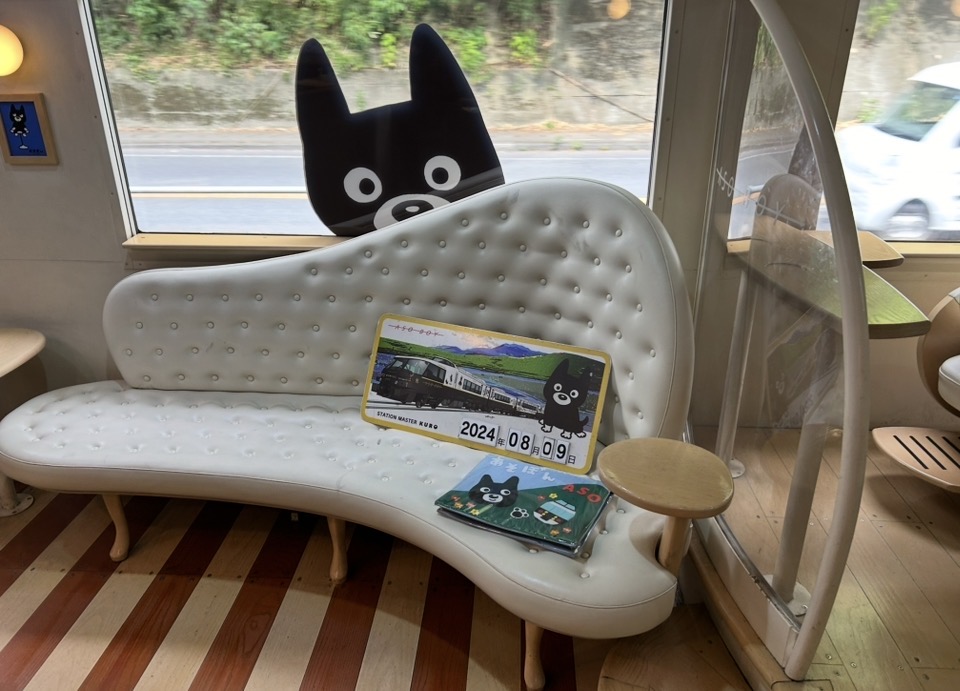


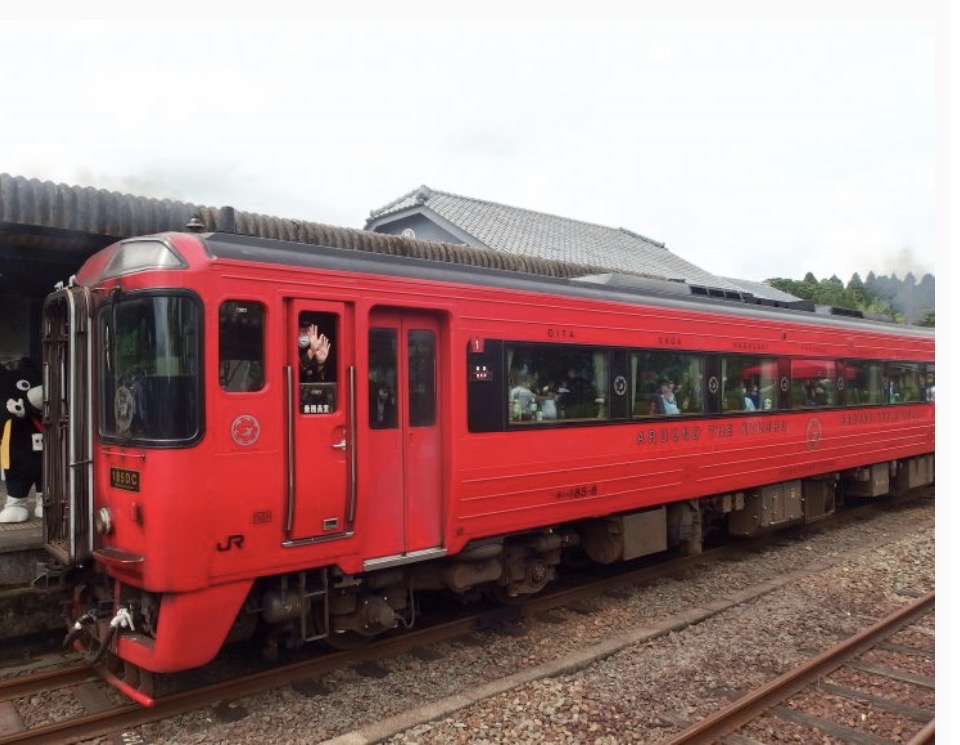
Today’s journey felt like a train pilgrimage. The relay began at noon: taking the Yufuin no Mori from Yufuin to Beppu, then continuing on the Aso Boy! to Aso.
After two hours of being pampered by the warm wooden interior and wide observation windows of Aso Boy!, we arrived at Aso Station . Here we bid farewell to the sightseeing train—it had to continue on to Kumamoto, while we still had to transfer to a regional train to Higo-Ozu . Platform changes were also required.
The Charm of Aso Station
I stood for a moment, taking in the atmosphere of Aso Station. The platform is iconic, conjuring a rustic Japanese countryside yet directly intertwined with the splendor of nature. From a distance, Mount Aso appeared, billowing smoke from its active crater, giving the sensation of standing in the middle of one of the world’s largest calderas.
Wooden elements dominate the supporting pillars and platform roof, creating a warm and welcoming retro feel. This design aligns with the classic main station building. As a major stopover for the Aso Boy! sightseeing train, decorations of “Kuro” —the train’s mascot—are everywhere. There’s even a small room called Kuro Ekicho-shitsu (Kuro Stationmaster’s Office) that brings a smile to anyone who sees it.
Aso Station is open-air. The fresh mountain air and surrounding greenery make time seem to slow down.
Dancing in Tateno
After less than ten minutes of waiting, the JR Hohi Line arrived. This is where the “real” adventure began. We no longer felt like tourists, but like locals commuting.
Upon leaving Aso, the regional train passed through small, quiet, yet charming stations: Uchinomaki , Ichinokawa , and Akamizu . I took a few pictures of the station signs. However, what awaited me was a surprise. As I approached Tateno , the train stopped briefly.
This is where the ritual of going back and forth takes place. Due to the extreme steepness of the cliff, the train cannot go straight down. In technical terms, this is the Tateno switchback . The carriages move in a zigzag motion, moving forward and backward at varying elevations. The driver even switches from one end of the train to the other to continue the journey.
Seeing the tracks we’d just crossed now so high overhead was a magical experience. This is the Japanese way of honoring nature: not by cutting through the mountains, but by “dancing” with them.
Change of Rhythm Towards the City
We were fortunate to still be able to witness the ritual, accompanied by the purple light of dusk slowly descending on the western horizon. Shortly afterward, as the sun completely set, the train arrived at Higo-Ozu .
Interestingly, even though we were still on the JR Hohi Line, we still had to change trains. The line between Higo-Ozu and Kumamoto used electric trains, while the train from Aso was still diesel-powered. The roaring diesel engines in the mountains were replaced by the quieter electric trains. We left the rural world behind and prepared to enter the urban rhythm.
From Higo-Ozu, the journey feels more regular, with eleven stops on the outskirts of Kumamoto. It feels like riding the Bogor-Kota or Tanah Abang-Angke commuter line. Stations pass by one by one: Haramizu , Sanrigi , and finally the modern Hikari-no-Mori .
Entering the city, the train passes Suizenji —famous for its beautiful gardens—then Shin-Suizenji and Heisei, before finally slowing steadily at busy Kumamoto Station .
The End of a Long Day
The hour-and-a-half journey is like a geographical summary: from the ancient crater of a volcano, diving through technical switchbacks , and ending in the pulse of Kumamoto city. Since departing from Yufuin this afternoon, more than seven hours have passed—filled with trains, sightseeing, and transfers in Beppu, Aso, and Higo-Ozu.
It was 7:30 PM. Before returning to Fukuoka by shinkansen, we stopped by the food court to find dinner. We chose teishoku , a Japanese set menu with two main dishes: saba no shioyaki (salt-grilled mackerel on a black plate) and gyūsara (beef served separately from rice). The set also included gohan and miso shiru, a dish containing seaweed and green onions.
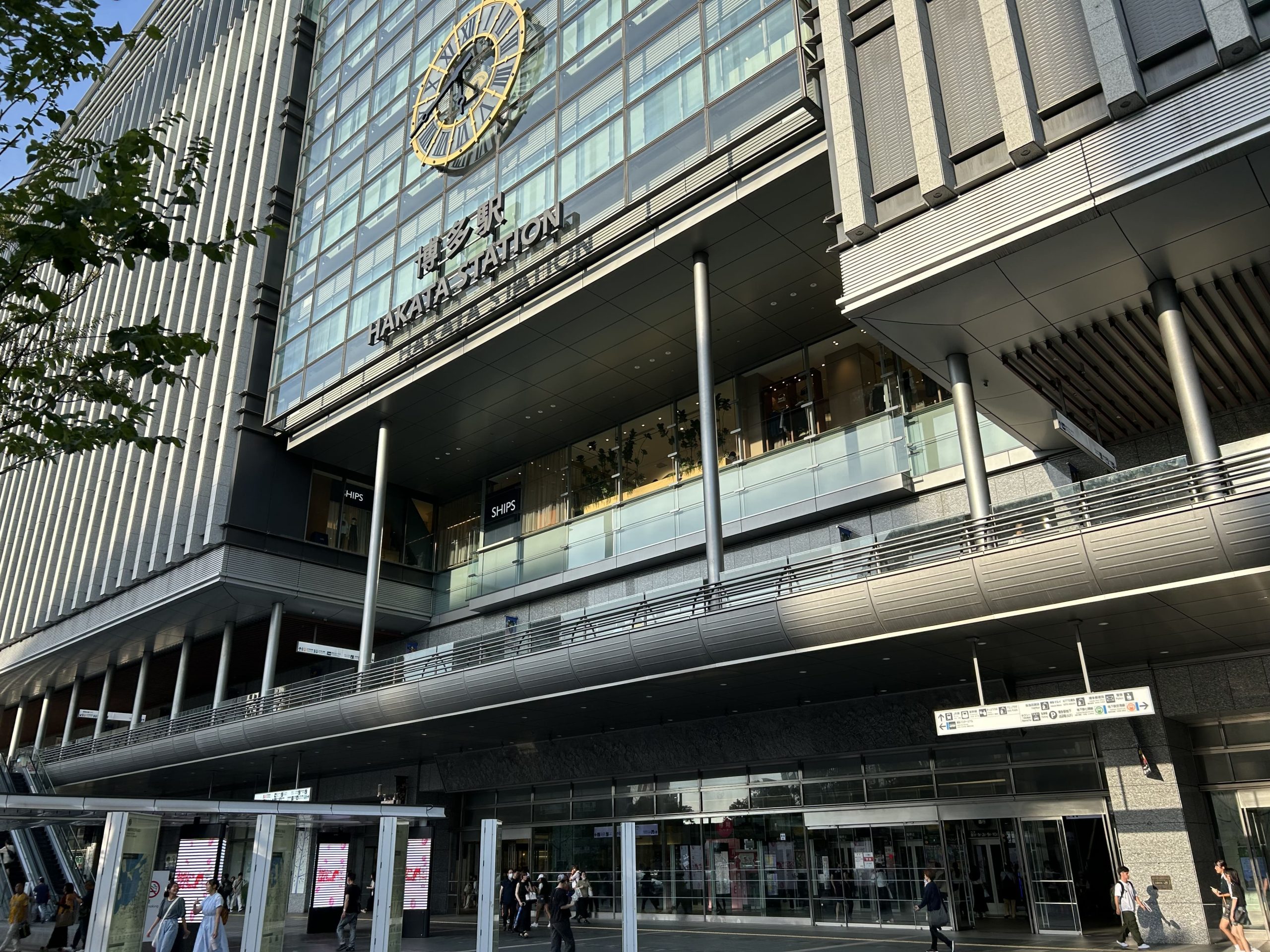
After eating, we headed to the shinkansen platform and took the Sakura to Fukuoka. It was almost 9:30pm when we arrived back at Hakata Station and checked in at ANA Crowne Plaza. The long day was closed by the hum of the train which slowly died down, leaving traces of the journey still warm in the head.