

“Come and go without worry, because happiness and blessings are born from your own heart.”
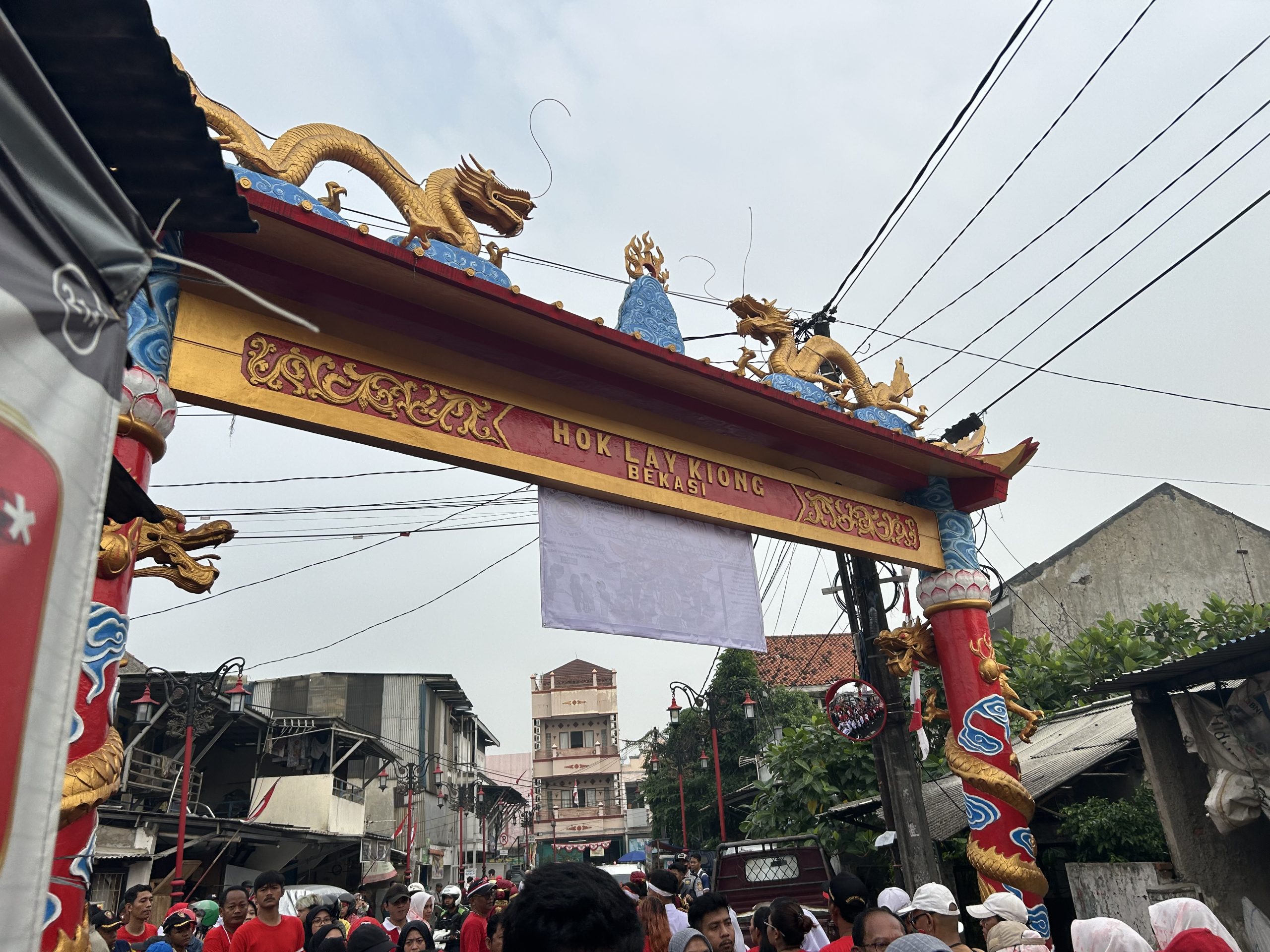
After lunch at Mie Ayam Surya, our bellies were all full and warm. The tables in the corner of the restaurant still had the aroma of fried garlic and chicken broth permeating the air. But that afternoon, instead of heading home immediately, we decided to satisfy the lingering curiosity we’d had since morning. There were several places we should have visited on our itinerary, but we’d missed them or only glimpsed them briefly. The first place we’d revisit that afternoon was a name Bekasi residents often mention when discussing the city’s Chinese history and traditions—the Hok Lay Kiong Temple.
There were seven of us: me, Mr. Sutiono, and five friends whose energy seemed inexhaustible—Mbak Amel, Hida Qudus, Kurnia, Mila, and Mirna. To others, our journey might have seemed like just another stroll. But for us, it was a continuation of the journey we had begun that morning. We returned along Jalan Mayor Oking and then turned left onto Jalan Kenari, where the temple gate stood as if to welcome us back.
On a long bench near the gate, several elderly Chinese women were chatting. Interestingly, their accent and language sounded like the Betawi dialect of the outskirts.
In front of the temple, the atmosphere was peaceful. There were no large groups, no hustle and bustle like earlier that morning. In fact, this gave us the freedom to take photos in the courtyard. Several of us took turns holding our cell phone cameras and then asked for help from a Chinese woman who had arrived with a white man. We later learned they had come to pray. The woman took our photo with a friendly smile, then went inside with her partner, incense in hand.
We stepped inside, greeted the temple guard, and asked permission. Our first step led us to the veranda—a transitional space between the inner and outer worlds, where a sense of history and spirituality began to be felt. Here, my gaze was immediately drawn to the five doors lined up before us. The doors had thick wooden doors; some were decorated with carvings of twisting dragons, others depicted gods wielding weapons and thick beards.
At first, I thought one of them was Kwan Kong, the valiant god of war. But when I asked Mr. Benny—who turned out to be the temple caretaker—he smiled and corrected me.
“No, that’s Men Shen, the doorkeeper,” he said. Wow, who would have thought that the hiolo that I saw this morning in front of the main door was dedicated to the doorkeeper god.
Ah, that’s right. Men Shen are not just decorations, but symbolic guardians believed to ward off evil and bring good luck. Interestingly, each door has a name inscribed at the top, written from right to left in accordance with Chinese tradition. The first door reads Run Gong Men , the next door Xuan Tian Ge .
Run Gong Men means “Palace of Virtue Door” or “Gate of the Hall of Virtue.” This name is typically used to denote the entrance to an area dedicated to a deity or altar representing virtue and compassion.
Meanwhile, Xuan Tian Ge means “Grand Heavenly Pavilion” or “Mysterious Heavenly Hall.” This name refers to the sacred space associated with Xuan Tian Shang Di, the Emperor of Heaven, also known as the Northern God or Bei Di, the protector against evil forces. These names are like doors to a world of symbols that can only be understood if we pause to read.
The veranda is also decorated with red lanterns, ranging from large hanging lanterns to small ones neatly arranged in rows. Each lantern bears the name of its donor—a tradition that ties spiritual connections to tangible contributions. From here, my view can penetrate inside, seeing the row of five doors from the other side.
Entering the main hall, the first altar that catches your eye is the shrine of three important deities: Kwan Seng Tek Khun (Guan Gong), Kwan Im Po Sat (Goddess of Mercy), and Cai Shen Loya (God of Wealth). Thin joss smoke billows, forming faint lines that dance in the air. The fragrance of sandalwood and incense fills your lungs, calming your mind.
On the right side, there is a relief of the Goddess Kwan Im flying gracefully on a lotus, and another unique relief: Kwan Im standing on a dragon, bringing a message of wisdom that overcomes wild forces. In the center is a relief of a god dressed in battle attire and carrying a sword. These reliefs feel alive, even though they are still. In front of the serene relief, there is a red donation box for the temple. It looks unique because the way to insert money or envelopes is by pulling and pushing the drawer.
On the other side, near a small pond filled with koi fish, stands a statue of a fishing god—reminding me of a similar statue I once saw in Lasem. This is a god named Jiang Taigong (姜太公). His full name is Jiang Ziya (姜子牙), a legendary Chinese figure from the Zhou Dynasty. He was known as a wise minister and strategist. This god is sitting fishing with a straight hook without bait, symbolizing patience, wisdom, and the belief that “the right person will come to you.”
At the edge of the pond, there is a plaque noting the temple’s renovation in 1990. Here, time feels like it flows in two directions: to the distant past, and to the tranquil present.
Mr. Benny, who introduced himself as the temple caretaker, was immediately appointed our guide. He began to tell us the story. “The master of this temple is Hok Tek Ceng Sin, the god of the earth and medicine,” he explained. Interestingly, the teachings embraced here are Tri Dharma—a combination of three major teachings: Confucianism, Buddhism, and Taoism. On the altar upstairs, statues of Confucianism, Buddha Sakyamuni, and Laozi sit side by side, symbolizing harmony across teachings.
When I asked what Hok Lay Kiong meant, Mr. Benny explained that Hok means good fortune, Lay means arrival, and Kiong means palace. So, Hok Lay Kiong can be interpreted as “Palace that Brings Good Fortune.”
Mr. Benny also explained that there are dozens of gods worshipped at this temple. The direction and order of prayer are actually regulated; each altar is even numbered and requires only one stick of incense. However, congregants are free to choose whichever god they choose to begin with. This suggests that despite the rules, freedom is still respected.
One interesting experience was watching people perform Ciam Si —a ritual of shaking small bamboo sticks stored in a tube, until one falls out. The number written on it will be matched with a fortune-telling paper. There are two types here: fortune-telling and medicine-telling. Mbak Amel and Kurnia tried, appearing solemn as they shook the tube, then paused to read the results. Mbak Kurnia got Ciam Si medicine from Kongco with the number 78. Kongco is the name for the host god, meaning great-grandfather, while the goddess, as in the Lasem temple, is called Makco. This yellow paper prescription for medicine number 78 in Chinese characters can be redeemed at sinshe, aka Chinese medicine healers.
Donation boxes are available in various corners of the temple. There’s a donation box for the temple itself, and another specifically for employees. “We even have Muslim employees here,” said Mr. Benny, pointing to two guards. One of them has worked here for forty years. This story emphasizes that the temple is not just for one religion, but also a place for interfaith gatherings.
On the wall, a notice lists the upcoming Cioko event on September 10th—a major ceremony to offer offerings to departed spirits. Mr. Benny explains that the date follows the Chinese New Year calendar, specifically the seventh month, known as the ghost month. Cit Gwee Cap Kau , or the 19th of the seventh month, is the peak of the Cioko celebration at this temple, although the actual celebration is usually on the 15th. I remember that in Hong Kong, Cioko is called the Hungry Ghost Festival in English.
We then went up to the second floor. Here, the Tri Dharma, or Sam Kau, is strongly felt with three statues standing side by side: Confucius, Shakyamuni, and Laozi. Next to them, a statue of Maitreya, or the Laughing Buddha, greets us, his protruding belly inviting a smile.
In another corner, a statue of Chao Kun Kong stands proudly. According to Mr. Benny, this is also one of the gods of medicine. This room feels brighter, perhaps because it’s higher up. As we descended, near the stairs, there were rows of wooden palanquins used to carry the god during rituals and festivals.
We spent over an hour at the temple, unraveling the history of the temple, which is over 300 years old. Mr. Benny also shared that the last renovation and expansion of this temple, which also includes a monastery, took place in 2020.
Before leaving, we took a group photo. But then it started to rain. The drizzle hit the courtyard, creating the aroma of wet earth mixed with incense. The rain grew heavier, so we canceled our plans to return to the town square.
We quickly ordered an online taxi. Before leaving the temple, shielding myself with an umbrella, I glanced back at the gate. I paused for a moment, reading the vertical inscriptions ( duilian ) carved on both sides.
On the left is written: Lai lai qu qu bu yong chou — “Come and go without worry.”
While on the right: Fu lu jie you xin zhong zao — “Happiness and blessings are born from the heart.”
Those words seemed to conclude today’s journey with a simple yet profound message: that this place is not just a beautiful building with a long history, but also a space to remember that everything we seek is already within our hearts.
We took a group photo, then said our goodbyes. As we walked out, the rain intensified, but somehow, our hearts felt lighter. Perhaps the saying “duilian ” was true—come and go without worry, for blessings are here, in the heart.