

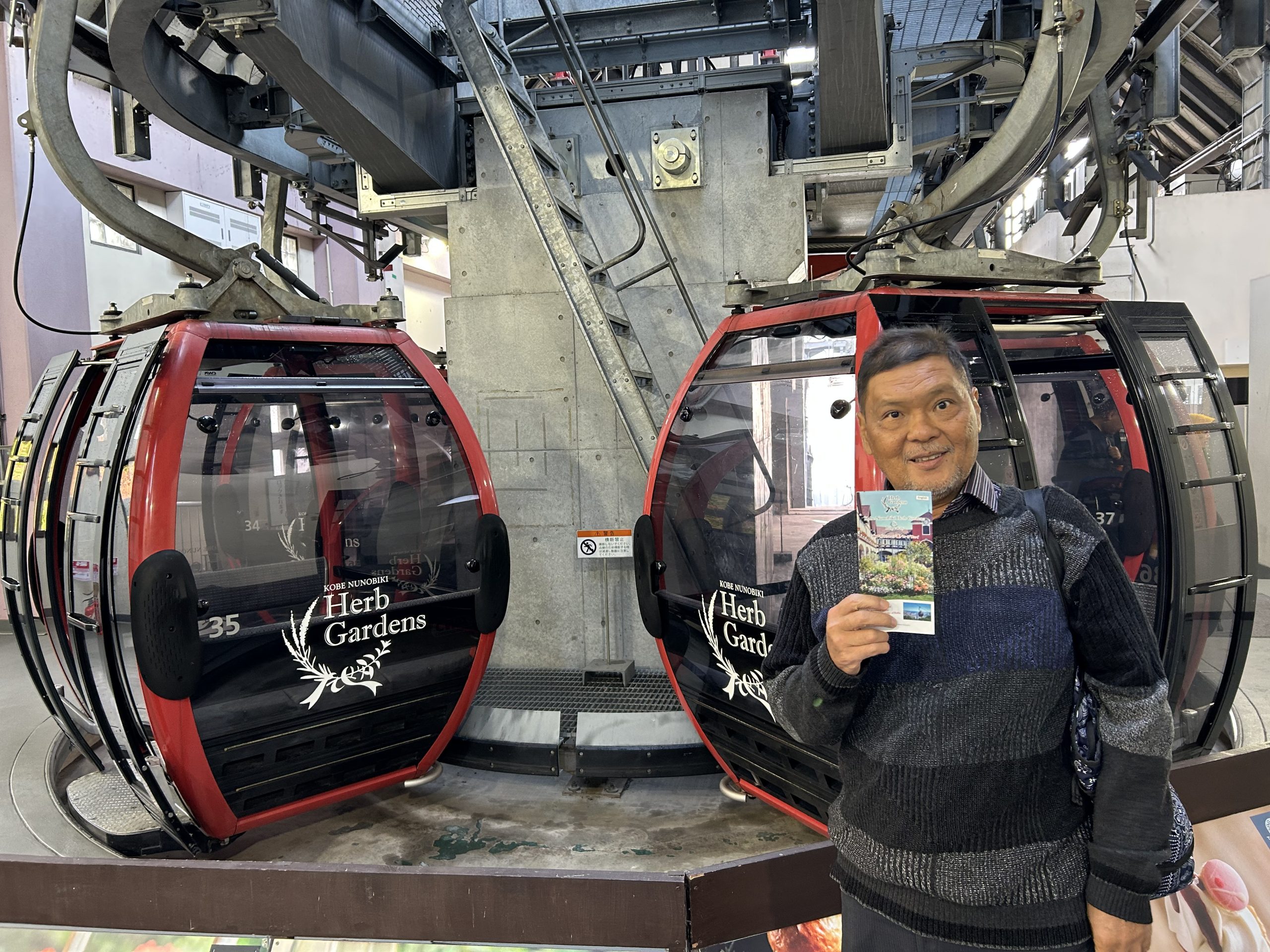
After a day spent simply walking around Osaka, today it was time to visit Kobe—a port city that always offers little surprises, from its rugged landscape to the oldest mosque in Japan. It was almost noon when we left our apartment and took a Go taxi to Jūsō Station. This time, we didn’t go to Nishinakajimaminamigata Station like we had the previous days, as there’s a Hankyu Line that goes directly to Kobe from Jūsō.
After getting out of the taxi, we walked about fifty meters along the pedestrian path to the station entrance. At the gate, I managed to buy an ICOCA card, as I only had three PASMO cards I’d bought in Tokyo a few years ago. With this card, traveling felt much more convenient—free access to public transportation and convenience stores as long as the balance was sufficient, without the hassle of buying tickets each time.
Jūsō Station looked ordinary, not too big or too busy. The building was simple, with almost no special feel. At first, I thought Jūsō was just the name of a neighborhood, until my eyes fell on the kanji. Only then did I realize that Jūsō means “thirteen”—a number known in Korean and Hokkien as chapsa. In kanji, it’s easy to remember: a combination of the cross symbol for ten and the number three represented by three horizontal lines. For some reason, the number reminded me of playing cards with a deck of cards or poker—a completely unscientific association, but it just happened.
After a short wait, a dark brown train pulled into the platform. From the outside, it resembled a Jabodetabek train, only the interior was neater, more elegant, and the passengers were much more orderly. We boarded the Hankyu Kobe Line Limited Express, which only stops at a few stations, including Tsukaguchi, Nishinomiya-Kitaguchi, Shukugawa, Okamoto, and Rokko. The train moved quietly, taking us slowly away from the glitz of Osaka and toward the gentler feel of Kobe. About thirty minutes later, we arrived in Sannomiya—a major hub of the port city, always bustling with people.
Sannomiya Station was quite large and bustling, but it still exuded a vintage feel. Our destination that afternoon was Nunobiki Herb Garden, so we had to change to the Kobe Subway for Shin-Kobe. There was only one station, but finding it was a bit of a hassle. Unlike Osaka’s Namba Station, which is well-marked, here we were a bit confused. We wandered around the station and came across a row of enticing Kobe Beef restaurants. “Let’s eat here tonight before we go back to Osaka,” my son joked, pointing to the brightly lit sign.
We continued walking until we arrived at a modern plaza with fountains, shady trees, and large abstract sculptures made of stone and metal, set against a backdrop of tall buildings. We still couldn’t find the subway entrance until we asked a couple of young men who kindly led us to a somewhat hidden elevator. From there, the journey back was easy. Just one station, and we were in Shin-Kobe, greeted by much clearer signs for the Herb Garden. Following the arrows, we arrived at the ANA Crowne Plaza Hotel, and soon the ropeway entrance came into view.
A round-trip ropeway ticket costs 2,800 yen, slightly more expensive because it was the Christmas and New Year period. I bought my ticket through the Trip app; I simply showed the QR code on my phone and exchanged it for a physical ticket.
The cable car ascended slowly, revealing a diorama-like view of Kobe. Rooftops were neatly arranged, streets gently curved, and the harbor’s silhouette peeked out in the distance. There were two stations on the ropeway, and we opted to go straight to the top. Upon arrival, the atmosphere changed completely. Christmas decorations greeted every corner: small fir trees, colorful lights, and German-style restaurant buildings standing gracefully, accompanied by soft Christmas music. Although the calendar was still November, it felt like the end of December.
The sky was slightly overcast, but the small plaza was warmed by red and green ornaments. A dark cylindrical structure resembling a chimney stood to one side, while the red brick clock tower behind it added a strong European feel. Ribbon-decorated tables are filled with visitors enjoying coffee, soup or just capturing the atmosphere.
We sat at one of the tables and ordered hot coffee and snacks. The coffee was more delicious than usual—perhaps it was the cool mountain air, or perhaps the view made time pass more slowly. The city of Kobe looked like a painting deliberately displayed that afternoon: modern buildings lined up neatly, the harbor visible as white dots, and the forests of Mount Rokko embracing the city in the distance. Without much conversation, we savored each sip in comfortable silence.
Once we were warm enough, we toured the summit area. Small, manicured gardens, paths among lingering autumn flowers, and European-style buildings looked even more beautiful under the orange leaves. In one corner, I stopped by the Fragrance Museum—a serene space with soft lighting. There, scent became a language. Lavender, chamomile, rosemary, all presented in small bottles. Lavender transported me to a quiet hotel room in Kyoto decades ago, while rosemary reminded me of the small kitchen in Yufuin where we once cooked a simple dinner. The scent museum felt like a small doorway to memories.
Exiting the museum, we descended the pedestrian path. In the distance, a large greenhouse reflected the pale sky. We had originally intended to go inside, but time was ticking and our energy was running out. We opted to just view it from afar—and that proved to be enough. The greenhouse looked like a picture from a postcard; sometimes, distance makes things even more beautiful.
Once satisfied, we took the ropeway back to Mid Station. The atmosphere was more relaxed. The winter lavender was pale, the green leaves lingered quietly, and the cable cars passing by provided a soothing backdrop. The carpet of white and pink flowers on the slopes reminded me of the cosmos flowers that often bloom in Japanese autumn.
Before I knew it, it was already past four in the afternoon. The sun was about to set. From Mid Station, we took the ropeway back down. Arriving near Shin-Kobe Station, our feet felt heavy. To make it to the Kobe Mosque before sunset, we ordered an online taxi.
The taxi driver, a middle-aged man, was quite talkative, though his English was limited. He conversed in Japanese with my son, who was sitting in the front seat—and fortunately, he understood quite a bit, having watched anime. About fifteen minutes later, the taxi stopped at the side of a main road, not far from the mosque. For some reason, it stopped early. We walked about a hundred meters toward the mosque.
As we approached the Kobe Mosque, rain began to fall slowly. At first, it drizzled, then became heavier. Under a belatedly opened umbrella, we walked quickly toward the mosque courtyard.