

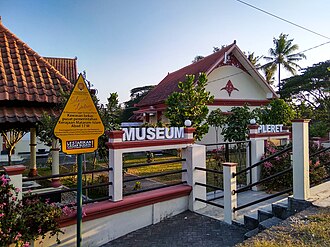
After driving for about thirty minutes from the Alun-alun Kidul area, we finally arrived in Pleret. Our main destination that afternoon was the Pleret Archaeological Museum, a place I had long wanted to visit, but for some reason had always put off.
As we arrived in front of the museum, I felt a little hesitant. There was no parking area like most museums. Instead, we had to direct our vehicles to a side entrance connected to the office area. Once inside, that hesitation was quickly replaced by relief. The museum was free. We were only asked to sign a guest book. That afternoon, the atmosphere was very quiet, with almost no visitors. There were only us and a museum guard who faithfully accompanied the silence.
The first room we entered immediately welcomed us with cool air, a stark contrast to the heat of Pleret outside. This room housed various artifacts from the past: temple fragments depicting gana—dwarf warriors of Lord Shiva—kebenan, the top structure of the temple fence, antefik, and jaladwara, a water channel within the sacred building. What brought this room to life was the presence of an audiovisual exhibition in the form of a light spot, explaining the origins of these objects, dating back to the pre-Islamic Pleret era. It wasn’t until we stepped outside that I learned the name of this room: the Gunung Kelir Room.
From there, we headed to the museum courtyard. Several gazebos stood majestically, their hipped roofs covered with reddish-brown clay tiles. The corners of the roofs were adorned with simple yet dignified Javanese ornamentation. Light-colored pillars supported the open, wall-less space, creating an airy and shady atmosphere.
In front of one of the gazebos, a large stone mortar rested on a stand. This stone mortar seemed to evoke the pulse of domestic life of the past—a place for pounding, processing, and working. It wasn’t a grand object, but rather its power as a daily marker that now bears witness to history.
This area apparently was the former kedaton (palace) of the Mataram Kingdom from the reigns of Sultan Agung to Amangkurat I. Its landmark is the Gumuling Well. What remains is a circular structure made of red brick, with a round lid and an iron handle at the top. Its distinctive shape is an old well, situated beneath an open canopy. Nearby, a plaque explains that this location is the Kedaton Cultural Heritage Site, Sumur Gumuling Sector, part of the ruins of the Pleret Palace, the center of the Islamic Mataram Kingdom during the reign of Amangkurat I (1646–1677).
This well is more than just the palace complex’s main water source. Locals believe it has a spiritual connection to the South Sea and is often used for rituals to purify heirlooms and heal. A question immediately arose in my mind: is there a connection to Sumur Gumuling in Yogyakarta’s Taman Sari? A question left hanging, like many other mysteries of Javanese history.
My footsteps then led me away from the silence of Sumur Gumuling, down a passageway of time to another courtyard directly adjacent to the main road. That is where the museum’s main entrance lies. A white gate stands firmly, a symbolic boundary between the hustle and bustle of the present and the grandeur of the past. The striking yellow lettering reading “Pleret Museum” seems to invite anyone to stop and explore the historical traces left on this land.
The midday sun filtered through the leaves of the shady trees, casting shadows on the path leading to the entrance. From behind the open iron fence, stone artifacts were neatly arranged on the green grass, as if whispering of the 17th century that was still lingering.
Back in the main courtyard, the paved walkway was neatly laid out. An iconic monument bearing the museum’s name and logo stood in the center of the area. A cloudy blue sky shaded the bright and welcoming atmosphere. In the corner of the courtyard, a mango tree bearing abundant fruit caught our attention. The ripe fruit looked tempting to pick, even though it was too high to reach.
We then entered the Kerto Room. This is where artifacts from the Islamic Mataram Kingdom era are displayed, complete with a historical timeline from 1613, when Sultan Agung founded Islamic Mataram, to the death of Amangkurat I in 1667 and the palace’s move to Kartasura in 1680. A statue of Sultan Agung stands in a glass case. Beneath it are inscribed wise words from the king.
One quote reads, “Swadana Maharjeng Tursita,” which is interpreted as a message that a leader must be knowledgeable, possess high intellect, and be skilled at communicating. On the other side is written, “Sharpening the sharpness of the mind washes away disaster,” a reflective call that feels relevant across time. There is also the teaching of “Rukti Setya Garba Rukmi,” which emphasizes the role of leaders in mobilizing potential for the prosperity and dignity of the nation—a principle used by Sultan Agung to legitimize his power, not only in Java, but throughout the Indonesian archipelago.
In the same room, a collection of umpak (pillars) is displayed, an important artifact from the era of the Keraton Kerta and Keraton Pleret. Not far from there, a collection of stamps depicting the sultans of the Indonesian archipelago, including Sultan Agung. Equally interesting is the display of Sastra Gendhing (Gendhing Literature). The Serat Sastra Gendhing by Sultan Agung is not merely a literary text, but a spiritual guide to life that discusses the relationship between humans and God, the origins and purpose of life, noble character, and the importance of balance between the physical and spiritual.
The museum also displays a replica of a tumpeng (rice cone) along with an explanation of its philosophy. The tumpeng is depicted as a symbol of humanity’s journey straight toward God. The color yellow symbolizes prosperity, white symbolizes purity, and the seven side dishes symbolize requests for pitulungan (helping) or assistance.
After exploring the museum, we returned to the courtyard. The mango tree was still standing, bearing its ripe fruit. Jokingly, we asked the museum caretaker for permission to pick one. She smiled sweetly, then shook her head slowly. No permission.
It was almost noon. My stomachs were beginning to give us a signal. It was time to leave the museum and find lunch.