

When we think of Agra, we immediately recall the beauty of the Taj Mahal. Therefore, if we visit Samarkand, Gur E Emir, the mausoleum complex of the Timurid dynasty kings, is the actual prototype of the Taj Mahal. Let’s follow its story.
Our journey in Samarkand continues from the Statue of Amir Timur in the University Boulevard area to Gur E Mir. The distance is only a few hundred meters and is a leisurely walk in the pleasant weather of Samarkand on the last day of August.
From a distance, the Mausoleum Complex looks majestic, with its large, beautiful bluish dome and two towering minarets.
The harmonious combination of the dome and minarets adds to the splendor of the Samarkand skyline. Even from a distance, the beauty and distinctiveness of Central Asian architecture, with its Persian, Mongol, and Turkic influences, beckon us to experience it up close.
As we stroll leisurely, Daniyor continues to tell us about the mausoleum. It is said that this complex was not originally intended as a mausoleum for Amir Timur, but was built in 1403 by Amir Timur for his favorite grandson and heir to the throne, Muhammad Sultan, who died suddenly at the young age of 27.
Previously, Muhammad Sultan himself had built a Madrasah (Islamic school) and a Kanakah (a kind of memorial complex and lodging for Sufis) on this site.
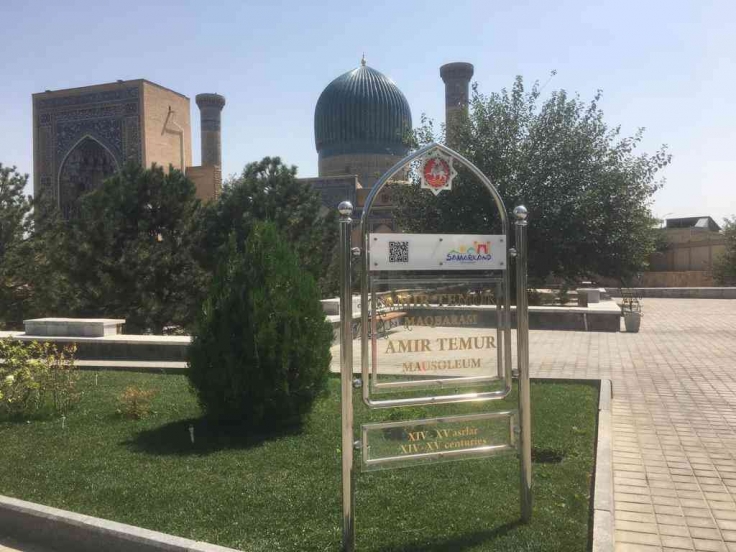
“Amir Timur Maqbarasi,” reads the Uzbek inscription on the transparent glass sign, complete with an English translation of the Amir Timur Mausoleum.
Above it is a QR code and the blue text “Samarkand” with a colorful sketch of the city, complete with the tagline “Enjoy Hospitality.”
After purchasing tickets, we entered the complex through a large gate called a gapura (pishtaq) in Persian.
This gate serves as the entrance to the iwan, a large rectangular room characteristic of historic buildings in both Iran and Central Asia.
Meanwhile, at the high pishtaq, with its arches and beautiful blue decorations, we are greeted by the distinctive splendor of Samarkand.
Here, we can read the name of the architect of the mausoleum complex, Muhammad Ibn Mahmud Al Isfahani, explaining his hometown of Esfahan, Persia.
And at the top, we can see the magnificent stalactite-shaped ornaments, also called Muqarnas. Beautiful and captivating, they are very Central Asian, with a Persian touch.
Passing through a beautiful gate, we enter the courtyard of the Gur Emir complex. To the left are the ruins of a madrasah first built by Muhammad Sultan in the late 14th century.
Similarly, to the right are the ruins of the Kanakah. The only remaining intact building is the mausoleum complex to the south, complete with two minarets, a dome, and a gate.
According to Daniyor, this complex once had four minarets. However, two of the minarets collapsed and were not restored.
From here, the mausoleum can be seen with its magnificent blue dome flanked by two beautiful minarets. The turquoise dome is onion-shaped and has 64 vertical ribs, which, according to legend, signifies the age of the Prophet Muhammad.
However, Daniyor commented that this number has nothing to do with the Prophet’s age. Near the pishtaq leading to the iwan, there are several benches for a brief rest.
To the left is a small, beautifully carved wooden door. This appears to be the door to the stairs that lead to the minaret. Near the door is a QR code that can be scanned for more detailed information about the mausoleum.
There is a souvenir shop and a row of Uzbek women posing for photos. The tall minaret, clad in colorful turquoise ceramics, appears to tower over Samarkand. Colorful ceramic ornaments in the shape of octagonal stars adorn the walls, which are said to symbolize the glory of Islam.
In this courtyard, there’s also a marble platform said to have been used for the accession ceremonies and coronations of Timurid kings. And if we look back at the pishtaq, or gateway, from the inside, it looks equally beautiful and majestic, flanked by a pair of trees.
Uniquely, near the pishtaq, the iwan, which would have been the entrance to the mausoleum, is enclosed by a white wall with beautiful wooden windows.
From here, we can peek into the inner chambers and rows of tombstones. Nearby is a map depicting the vast territory of Central Asia and its surroundings that once belonged to the Timurid dynasty.
The entrance to the mausoleum itself is set back several meters, forming an equally beautiful arch. A beautifully carved wooden door welcomes us, and inside is a room displaying a portrait of Amir Timur and a map of his realm.
There’s also a depiction of the genealogy of the Timurid kings, which traces back to Babur, who later founded the Mughal Dynasty in India.
The journey through the mausoleum continues with the entrance to the main chamber. Golden light immediately shines here. Understandably, almost all the walls are decorated with gold-plated ornaments.
The interior of the dome appears more spacious from the inside, while the lower walls are made of onyx, giving it a transparent appearance.
The interior walls are decorated with muqarnas, and a crystal chandelier hangs from beneath the main dome. A sense of silence and serenity permeates the mausoleum. Only a few Uzbeks are seen praying and sitting on chairs near the walls.
In the center, just beneath the dome, are several tombstones. There’s also a diagram showing the names of each tombstone.
Amir Timur’s tombstone is in the center and is made of emerald or green jade. Nearby are the tombstones of his two sons, Mirah Shah and Shah Rhuk, and of course, his beloved grandson, Muhammad Sultan.
Also, there are the tombstones of his grandson, Ulugh Beg, the renowned astronomer, and Amir Timur’s spiritual mentor, Sayyid Barakah.
Like the tombs at the Taj Mahal, only the tombstones are visible here; the actual tomb is underground and accessible through a small door from outside the mausoleum, still in the courtyard of the Gu E Amir complex.
“Otkuda Vi?” an Uzbek couple who had been praying asked where we were from when I sat down for a moment not far from them.
A quiet conversation ensued for a moment, out of respect for this sacred place. Shortly after, after offering prayers to those buried there, we returned to the courtyard and continued our journey to the back of the mausoleum.
There’s a souvenir shop underground, and the sight of interesting souvenirs at relatively affordable prices enticed us to shop.
Moreover, Agus, who can handle transactions in Uzbek or Tajik, made the prices even more attractive.
Most tourist attractions in Uzbekistan, including mausoleums, madrasas, and mosques, are equipped with beautiful and tempting souvenir shops.
Uniquely, most madrasas in Uzbekistan now function solely as tourist attractions and souvenir shops.