

After lunch and prayers at Loulan Islamic Restaurant on Rua de Cinco Outubre, we planned to continue our journey to Taipa Island to see modern Macau, including its magnificent casinos.
According to the restaurant attendant, not far down the road, we could cross a bridge and turn right to Ponte 16, a casino complex that also houses the Sofitel Hotel. From there, we could continue to the other casinos on Taipa Island. Indeed, one of Macau’s advantages is the casinos’ free shuttle bus service, making it easy to get to wherever we needed to go.
Historic Traces at Ponte 16
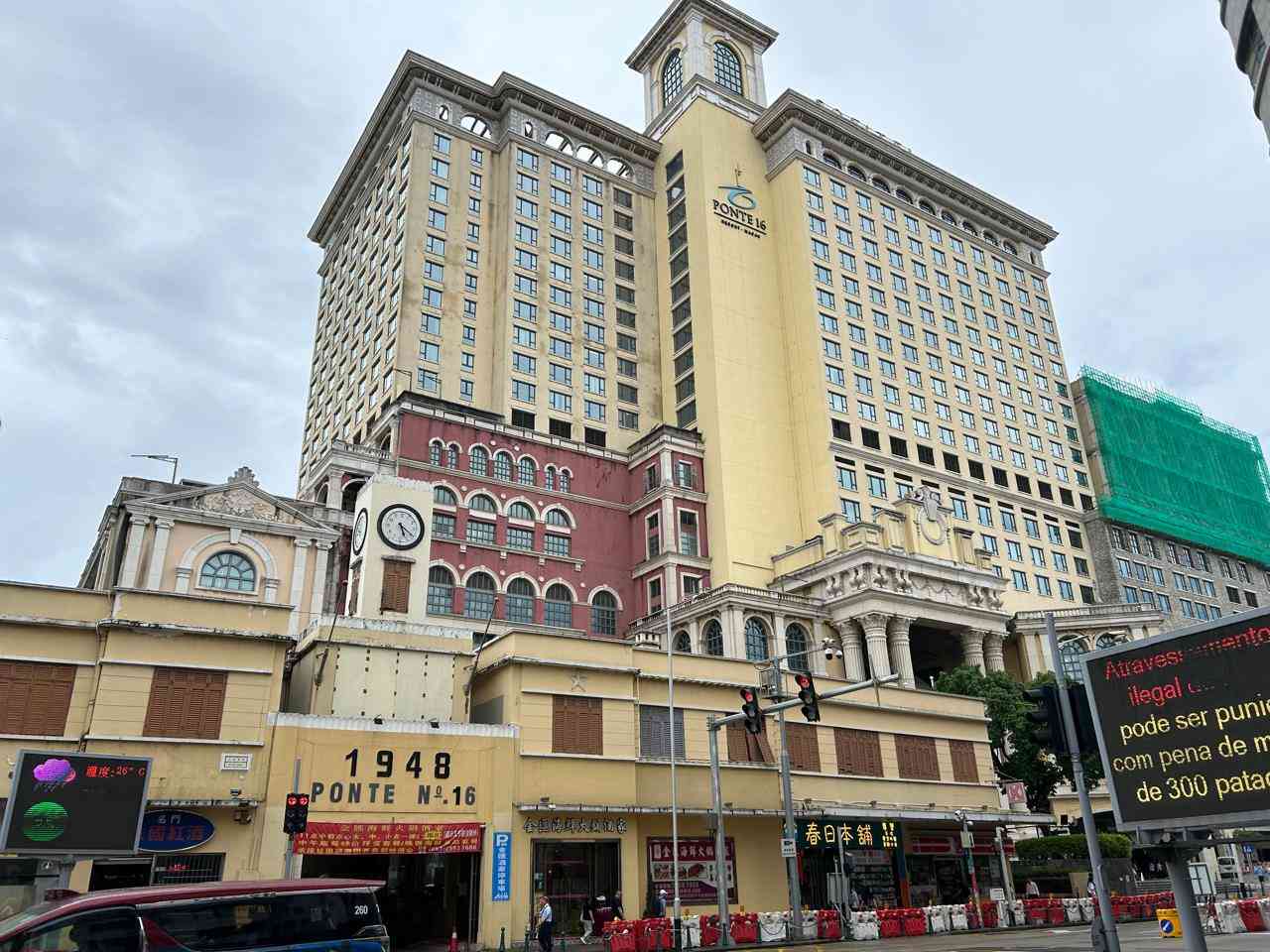
We strolled leisurely across the pedestrian bridge, which has an elevator, although there are only stairs on the other side of the street. We arrived at Ponte 16, which looked majestic and imposing.
Interestingly, in front of this modern casino was the remains of an old building with a clock tower that read “1948, Ponte No. 16.” It was like a reminder of layers of history dating back centuries. Not far away, we saw a street sign in Portuguese, Rua do Visconde Paco de Arcos, with Chinese characters written on it.
In the front yard of Ponte 16, a unique car resembling a large VW Kombi, painted orange and white, was displayed with the word “OLA” on the wall. Next to it, a giant stuffed cat sat. [VW and cat.]
Free Trip to Portas do Cerco
Right in front of the casino hotel, a dark purple bus was picking up passengers. When we inquired, we learned it was headed to Portas de Cerco, or Barrier Gate, the border crossing between Macau and mainland China (Zhuhai). The attendant, who appeared to be a South Asian migrant worker, added that many casino buses depart from this border crossing to various locations on Taipa Island.
We quickly got in line and boarded the bus. The ride was free, comfortable, and cool thanks to the air conditioning. I had only seen the word “Portas de Cerco” on street signs or buses, but I had never been there. Since we were planning to cross into Zhuhai tomorrow using the Visa on Arrival facility, today was a good opportunity to get a glimpse of the border crossing.
Macau’s status as a Special Administrative Region (SAR) means it will remain administratively independent from China until 2049, although sovereignty was returned to Portugal in 1999.
Peeking at Checkpoint Charlie from the Far East
The bus weaved through the dense traffic of Macau. Although it looked close on the map, the trip from the casino to the border took about 15 to 20 minutes. The typical Macanese street names were written in both Chinese and Portuguese.
As we approached the bus terminal at the border, the atmosphere was bustling. People were rushing to cross into Zhuhai on foot. Here stood a magnificent and large border post, its architecture resembling an airport. This border post, called Gong Bei Kou An, was no less magnificent than the one we visited this morning after crossing the Hong Kong-Zhuhai-Macau Bridge. [Portas do Cerco] (Personal Documentation)]
After getting off the bus, we had to navigate through the crowds heading to Zhuhai to reach the row of casino shuttle buses. There were buses from the Venetian Macau, Galaxy, Parisian, Hotel Lisboa, Wynn, and MGM. We simply chose the one that best suited our destination.
Not far from the bus terminal, our attention was drawn to a monument: an old gate surrounded by a fence. This was the Portas de Cerco, or Barrier Gate, built in the mid-19th century by the Portuguese. The yellowish-orange gate looked elegant and contrasted sharply with the modern border building behind it.
In the simple archway, there was a fountain. On either side of the door was an inscription and the words in Portuguese: “A patria honrai, que a patria vos contempla”—which roughly translates to “Honor your homeland, so that your homeland will protect you.” Other inscriptions recorded the dates August 22, 1849, August 25, 1849, and October 31, 1970.
Once, hundreds of thousands of people crossed the border through this ancient gate. Important events such as the Passaleou incident in August 1849, which solidified Portugal’s position in Macau, are chronicled here.
In fact, in the 1950s and 1960s, many Chinese sought to cross into Macau and Hong Kong. Due to the tensions of that time, Portas de Cerco became known as the Checkpoint Charlie of the Far East.
Of course, things have changed considerably. As the economies of China and Macau have developed, residents and millions of tourists can freely cross this modern border, as we would do the next day.
After about half an hour of walking around this historic area, we boarded the casino shuttle bus again, this time heading near our hotel, still on the Macau Peninsula.