

Travel Report from Hainan by Taufik Hidayat
The afternoon sky in Hainan was a mauve hue as the chants of Poco-Poco echoed from an open-air stage. Rows of round lights hung between coconut trees, casting golden light onto smiling faces. Amidst the crowd, dancers dressed in orange batik swayed their hips energetically. The audience—both Indonesian tourists and local Chinese—joined in, imitating the movements that somehow united them in a common rhythm.
“Ngana pe goyang pica-pica…”
The lyrics were loud, humorous, and full of nostalgia.
But this wasn’t Bali. This was a Balinese village on Hainan Island, China.
The journey to this place began after we left Yalong Bay International Rose Valley, a fragrant rose garden on the island’s southern edge. Our bus drove along the coastal road to Xinglong, Wanning, a region known for its lush and tropical charm—a Chinese fusion of Denpasar and Bogor.
On the bus, our local guide, Angela—or Xiao Long, as she introduced herself—was asked to sing a Hainanese folk song. Her voice was soft, like the evening breeze weaving through coconut trees. The song spoke of longing for her homeland, and somehow, its melodies felt familiar to our ears, as temporary migrants.
Soon, the bus stopped in a spacious courtyard with a stone plaque reading “Bali Village.” The letter “A” there resembled the Bentar Temple, as if offering a traditional Indonesian greeting to each arriving guest. Nearby, a metal plaque declared the tourist attraction AAA-rated, part of the official ranking system of the Chinese Ministry of Tourism, which rates the quality of tourist attractions from A to AAAAA.
Angela smiled proudly, “This is a favorite spot for Indonesian tourists. They say they can get to Bali without flying overseas.”
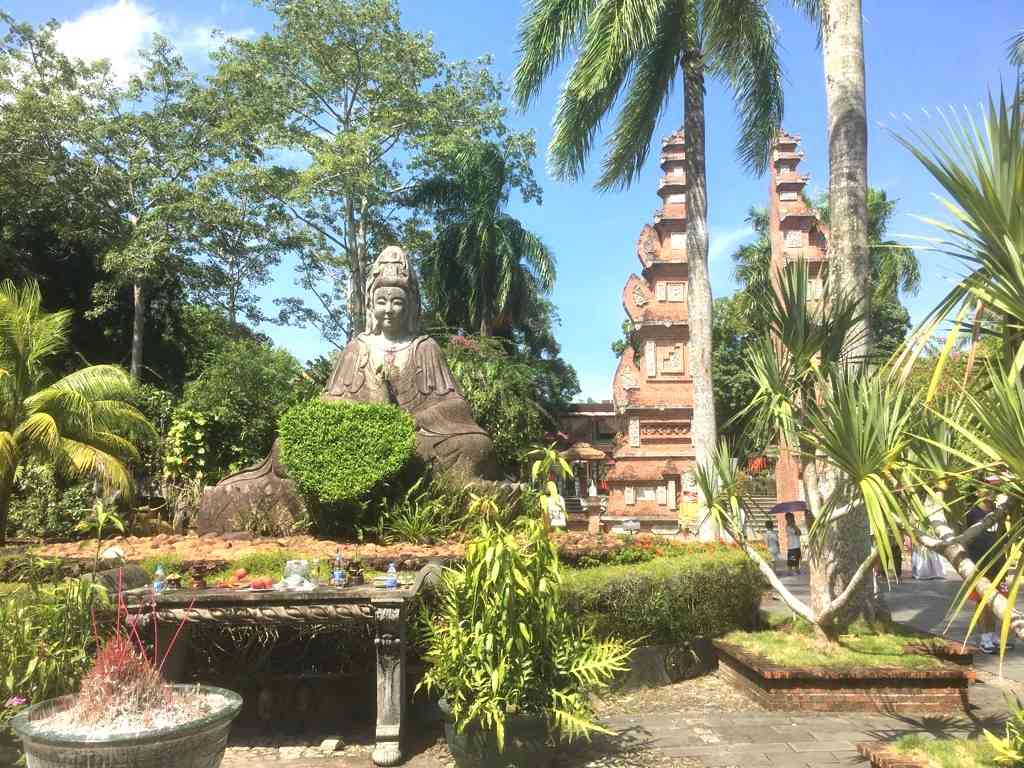
As soon as we passed through the gates of the Bentar Temple, the atmosphere changed dramatically. The warm air was scented with incense, gamelan music wafted softly from the speakers, and the path was lined with rows of coconut palms and plumerias blooming with yellowish-white flowers. If it weren’t for the Chinese-lettered signs on the walls, I might have thought I was in Gianyar.
To the left of the gate stood a statue of the Goddess Kwan Yin, seated in the lotus position, her smile serene, as if blessing the cultural intermingling that was taking place around her.
Not far away, a sign reading “Santai Sejenak Belajar Bersama” displayed a list of simple Indonesian vocabulary words and their Mandarin translations:
Thank you = Xie Xie,
How are you = Ni Hao,
Welcome = Huan Ying.
A small but pleasant attempt to bridge language and hospitality.
We walked deeper into the garden, where a Balinese Barong statue stood majestically with its bulging eyes and distinctive fangs. Its face was intimidating, but beneath it, there was an inexplicable charm. According to our guide, Mr. Parjoni, most of the ornaments here—from the stone carvings to the poleng cloth—were made directly by artisans brought in from Bali. Several Balinese architects were even involved in the complex’s construction.
From there, we moved on to a small gallery showcasing the history of the Balinese Village in Xinglong. On the walls were black-and-white photographs: ships docked, Chinese families returning from Indonesia, and young faces trying to cultivate hope in a new land.
The story began in the 1950s and 1960s, when Indonesia enacted Government Regulation No. 10, which restricted the trading activities of Chinese citizens at the sub-district level. As a result, thousands of people chose to “return” to their ancestral homeland. But for some of them, “returning” didn’t mean returning to a familiar place. The Chinese government at the time settled many of them on Hainan Island, which was then still considered a remote and harsh region.
Time passed. They built houses, planted trees, and slowly cultivated the memories of Indonesia they brought with them. From this, a new community was born—Chinese who speak Indonesian and various regional languages across the archipelago, cook with Indonesian spices, and grow coffee.
One of the most interesting stories in the gallery is about Xinglong Coffee. A large photograph of Premier Zhou Enlai hangs on the wall, enjoying a cup of coffee. The caption below reads: “Prime Minister Zhou praised Xinglong Coffee as the best in the world.”
Ironically, coffee itself originates from Indonesia. In 1954, a Chinese-Indonesian named Lin Yongxiang returned to China with 20 pounds of coffee seeds from his homeland. He planted the seeds in Hainan, and from there, Xinglong Coffee, now a local pride, was born.
I smiled as I read this story. Outside, the faint aroma of roasting coffee wafted through the air. It was like a secret bridge connecting two tropical islands in two different countries through a single cup of coffee.
From the gallery, we headed to the Taiyanghe Stage, where traditional Indonesian dance performances were held every thirty minutes. As gamelan music played, young dancers appeared on stage dressed in Balinese, Sumatran, and Sulawesinese costumes. All of the dancers were local Hainan residents who had learned Indonesian dance. Their movements might not have been perfect, but their enthusiasm was infectious.
When the music shifted to the Poco-Poco rhythm, the atmosphere instantly erupted. The audience stood up, danced along, and laughter echoed in the tropical Hainan air. There was something sincere in the pounding of footsteps and the swaying of hands—a kind of unspoken acknowledgement that culture belongs to no one, but to all who are willing to share in the joy.
After the performance, we wandered around again. On the side of the road, a small stall sold ivory coconuts for 10 yuan each. The juice was sweet and cold, though the flesh was inedible. A few meters away, young girls posed in traditional Thai—not Balinese—dress in front of a replica temple. They looked happy, despite their misdressing. “Maybe for them, everything tropical is Bali,” a friend remarked, and we chuckled.
Two hours passed quickly. As the bus began to pull away from Bali Village, I glanced back. The Candi Bentar Temple in the distance seemed to fade, but the sound of Poco-Poco music lingered faintly, as if sending off a humorous farewell.
I stared at the cup of Xinglong coffee in my hand. The taste was smooth and slightly bitter—like nostalgia brewed in two countries.
And I realized that this trip wasn’t just a tourist visit, but a small snapshot of how cultures travel long distances, cross oceans, and find new homes in places we never expected.