

Our journey in Hainan continues. After a morning visit to a legendary traditional Chinese medicine factory, our next destination is one of China’s most famous rose gardens, Yalong Bay Rose Valley, sometimes called Yalong Bay Rose Park.
On the way to the flower garden, our tour guide talked extensively about Hainan Island and briefly explored the history of the rose garden. Along the way, we were met with numerous areca nut plantations and swaying coconut trees. Hainan is indeed the coconut island, making the atmosphere here seem a bit like home.
Yalong Bay International Rose Valley, the official name of this rose garden, greeted us in both Chinese and English. It turns out this place also has a rating as a tourist attraction, but only a Triple A (AAA) rating compared to the 5A rating for the Guanyin Statue on Nanshan we visited yesterday. We were given entrance tickets, all inscribed with Chinese characters, decorated with silhouettes of roses and a man and woman holding hands, exemplifying the romantic atmosphere of the place. “Love begins from here,” reads the ticket.
As is typical of tourist attractions in Hainan, a “odong-odong” (motorized carriage) or electric car is provided for visitors to relax from the gate to the rather distant flower garden. Therefore, it’s not surprising that the ticket price is quite expensive, around 90 Yuan.
We arrived at the reception, where a local guide was ready to briefly explain the Flower Garden. There were also stalls selling drinks, snacks, ice cream, and even traditional Miao and Li clothing, the indigenous inhabitants of Hainan Island, for sale or rental. At first glance, this traditional attire resembles some traditional attire from Indonesia. To purchase food and drinks, besides cash, you can also use Alipay QR, which is widely available in China. The best part is that you can also use Alipay, linked to your savings account in China.
The tour guide then explained the information in Mandarin, which was translated by the tour guide into both English and Indonesian. One attraction involves the use of white rose petals, which are filled with a fragrant aroma. However, according to tour guides, the roses aren’t as beautiful in the hot month of August as they are in spring, around April and May, or in autumn, around October, when temperatures are more pleasant. This rose garden, or valley, covers nearly 200 hectares and is the largest rose garden in Asia. Besides being a tourist attraction, the garden also serves as a breeding and cultivation center for roses used in the industry, particularly perfume. Many world-class brands reportedly source their perfume ingredients from this location.
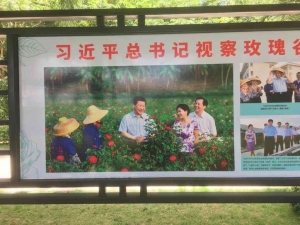
One of the exhibits depicts President Xi Jinping and the First Lady chatting with rose farmers among blooming red roses. This apparently refers to the Chinese president’s visit to the garden on April 9, 2013. The rose garden has attracted many tourists and increased incomes for farmers and local residents.
We then strolled through the flower garden and saw roses in a variety of colors, including red, pink, yellow, purple, and even light green. Each had its own distinct fragrance. There are also many interesting photo spots here.
One of them was a large inscription on a book-shaped stele, supposedly a speech by Xi Jinping on April 9, 2013. Unfortunately, I couldn’t read it, and even with the help of a gadget, the translation was poor. With the help of a friend, I finally understood the meaning of the inscription: “Xiankang bu xiaokang guanjian kan laoxiang.” It turns out to be a string of pearls of wisdom, meaning whether or not we succeed in becoming a prosperous society depends on the villagers.
After about half an hour of enjoying the beauty of the rose garden, we continued our journey by stopping at a shop selling perfume made from rose essence or oil. Besides perfume, it turns out there are many other products, even foods, made from roses.
However, my first impression upon visiting this place, which is apparently owned by the Chinese government, was the strong political messages. One such message is displayed in the slogan at the front of the park, complete with a hammer and sickle logo.
And it turned out that during the bus ride, the tour guide also shared many stories about his impressions of President Xi Jinping as a citizen. According to the tour guide, who has two young children, Xi has made many changes that have made him even more beloved by the people. In fact, he is currently in his third term after successfully amending the law that previously limited presidential terms to two. Therefore, Xi Jinping has the potential to become president for life.
One of the things he talked about was the One Child Policy, which once shackled most Chinese people, as each couple from the Han ethnic majority was only allowed to have one child. This policy was implemented to address the country’s population surge. However, over 30 years later, it has resulted in a younger generation having to support many elderly people in addition to their own children. With China’s improving economy, the elderly population is growing. As they retire, they become dependent on their children. If they only have one child, that one child can support two parents, and even four if they are married.
Fortunately, the one-child policy was abolished in 2015, and the Chinese government now encourages young couples to have more children. Each child receives a government allowance. It’s said that since 2016, couples in China have been allowed to have two children, and since 2021, they have been allowed to have three.
Who would have thought that a trip to Hainan Island would expand into a brief discussion of Chinese politics and economics?