

After lunch at the Indian-Nepali restaurant Lumbini, our stomachs felt warm and full. The aroma of spices and seasoned rice lingered on our tongues. We felt we had enough energy to explore Nara again.
From Kintetsu Nara Station, we crossed to a bus stop decorated with a deer illustration in large blue letters: “I” for Information. Next to it stood a digital map showing the bus’s location in real time—a small luxury that travelers like us found pleasant.
A gentle autumn breeze blew, the chill biting but not chilling. Five minutes later, bus number 178 arrived, the rear doors opening automatically. We remembered the unspoken rule: board from the back, get off from the front door near the driver, and simply tap our IC cards.
A warm atmosphere enveloped us as soon as we entered. The seats were neatly arranged, and a digital screen at the front displayed the next stop. The bus slowly moved through the tall trees of Nara Park; the leaves were beginning to fall, as if preparing for winter.
We got off at the stop directly across from the classical-style building of the Nara National Museum. A few steps away, a bright red torii gate loomed. Above it hung a wooden sign bearing the kanji for “氷室神社”—Himuro Jinja.
A stone path led us into the complex. The trees drooped, their brown branches hinting at the end of autumn. Several women in kimonos strolled slowly, adding to the traditional atmosphere. Stone lanterns lined the right side, while on the left stood a small shrine building.
Himuro Jinja was no ordinary shrine. The name “Himuro” means “ice storage room.” In 710, when the capital was still in Heijō-kyō (Nara), the palace relied on frozen ice from mountain ponds. Ice was collected in winter, stored until summer, and then offered to the palace as a prayer for prosperity. This tradition continued for decades until the capital was moved to Kyoto. Since then, the shrine has served as a place of worship for the god of ice. Every May 1st, the Kenpyōsai festival is held: a ritual of ice offerings, ice lanterns, and the tradition of ice divination—letters of fortunes slowly appear when paper is attached to a slab of ice. This tradition is called Ice Omikuji, similar to the ciamsi in Chinese temples, only the medium is ice.
We were silent for a moment. How even a small symbol like ice was sacred, becoming a long prayer for the harvest, the weather, and the survival of ancient societies.
From the shrine, we crossed back to the park. Deer emerged from behind the trees, like locals shamelessly greeting guests. The path to the museum was crowded with tourists: some chuckled as the deer approached, others panicked and ran away. I remembered seven years ago in Itsukushima (Miyajima), where deer also casually snatched paper from tourists’ hands. So we remained cautious, lest they devour even the yen bills.
Not far from where we stood, a woman in her fifties was selling roasted sweet potatoes from a simple cart. A thin smoke billowed from the stove; The aroma of caramel and firewood danced in the cool air. I asked, “Nan desuka?” She replied kindly: yaki-imo—Japanese roasted sweet potatoes—300 yen per 100 grams. Not far away, a couple of foreign tourists waited for their sweet potatoes to cook.
We stopped in front of a large information board. The main poster featured two muscular, ferocious-looking giants: the Kongō Rikishi, or Guardian Deities. The left figure, with its mouth open—the sound “A”—symbolized the beginning. The right, with its mouth closed—the sound “Un”—symbolized the end. They usually guard the gates of large temples like Kinpusen-ji in Yoshino, but now they were “guests” at the museum. Had we gone inside, we would have been able to see the detailed wood grain and carvings of the guardians, as well as the rows of Buddha statues from the Nara period and the collection of ancient bronzes. But time was short.
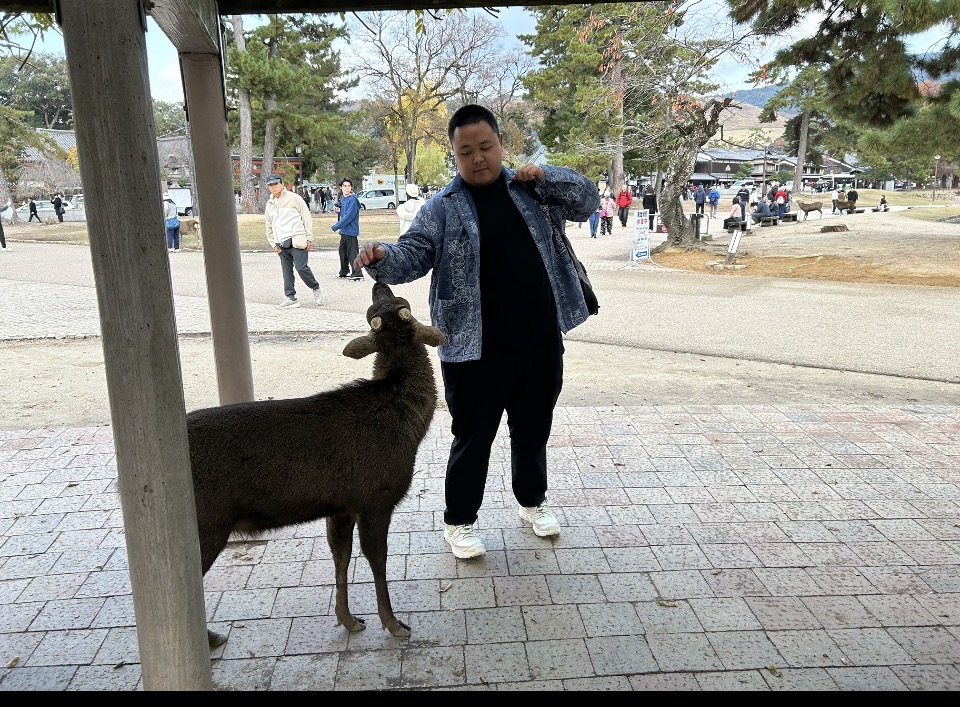
We walked to a pergola with wooden chairs and sat for a while. A deer approached, as if begging for a biscuit. My son happened to have a small bag with him, and he gently offered it to us. The interaction was brief but pleasant.
Not far away stood a sign depicting a stag. Mating season is underway; although docile, deer are still wild animals. They can bite, kick, gore, or even throw themselves at visitors. Therefore, male deer antlers are trimmed at the beginning of mating season to prevent them from endangering humans.
I sat interacting with a deer again, this time more carefully. Occasionally, I offered them sikashibei biscuits. If they ran out, simply showed them both empty hands—they usually understood and left us alone.
The sun was beginning to set, leaving a faint warmth. To the left was the Buddhist Sculpture Hall, also part of the museum complex. Tourists came and went; time seemed to flow slowly, leaving a sense of peace rarely found in a big city like Osaka.
After nearly two hours enjoying the sunset at Nara Park, we headed back to Kintetsu Nara Station, ordering an online taxi. Our destination was Namba Station in Osaka. However, my two children asked to get off at Tsuruhashi; from there, they could more easily transfer to the Osaka Loop Line to continue their journey. My wife and I headed straight to Namba, then transferred to the Midosuji Line.
The day trip felt short but meaningful—a mix of spices from the Lumbini restaurant, the cool autumn breeze, the icy history of Himuro Jinja, and the antics of deer that never quite tame. There’s something about Nara that’s hard to describe. The ancient and the sacred blend seamlessly, as if time slows down to remind us that nature, history, and life once coexisted before everything became the rush of a modern city.